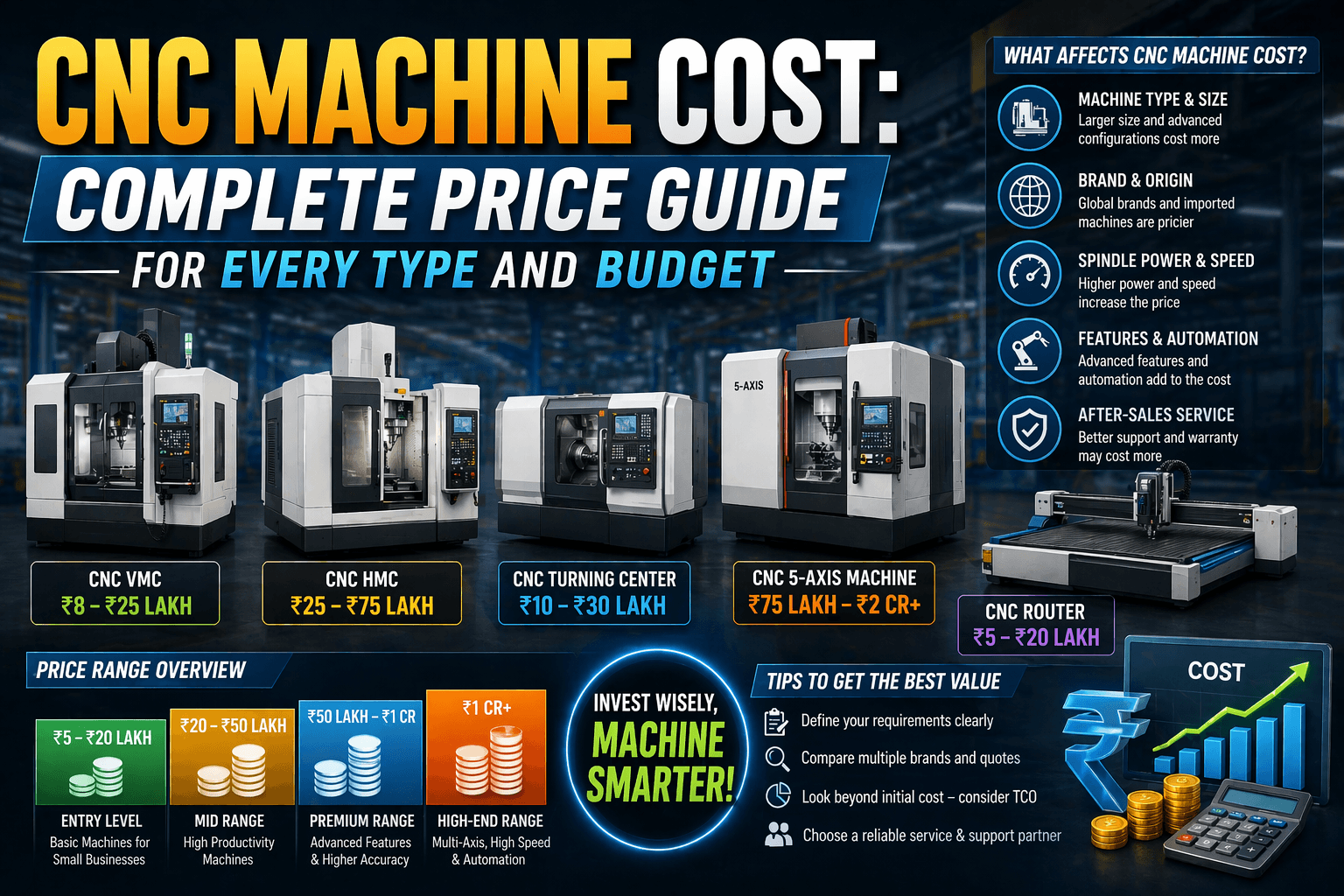
CNC machine costs range from ₹50,000 for a hobby desktop router to over ₹5 crore for a premium 5-axis machining center. In the USA, entry-level CNC machines start at $5,000 and industrial machines exceed $500,000. The right price depends on the machine type, spindle power, controller brand, and production volume requirements.
How Much Does a CNC Machine Cost? The Short Answer
There is no single answer because CNC is not a single machine. The term covers everything from a desktop wood router that a hobbyist runs in a garage to a 5-axis titanium machining center running inside a defense aerospace plant.
The honest answer is this: CNC machine prices span five orders of magnitude. A desktop hobbyist router costs roughly the same as a smartphone. A high-end production machining center costs roughly the same as a commercial aircraft interior.
What you actually need to know is the price range for the machine type relevant to your application. This guide breaks it down completely.
What Is the Starting Price of a CNC Machine?
The starting price of a CNC machine depends entirely on what you define as a CNC machine.
- Desktop CNC routers for hobby use: Starting at ₹40,000 to ₹1.2 lakh in India ($500 to $1,500 in the USA). These machines cut wood, plastic, soft aluminum, and foam. They are not production machines. They lack the rigidity, spindle power, and coolant systems required for industrial use.
- Entry-level industrial CNC lathes: Starting at approximately ₹4 lakh to ₹7 lakh in India ($8,000 to $15,000 in the USA) for basic 2-axis CNC turning machines from domestic manufacturers.
- Entry-level VMC (Vertical Machining Center): Starting at approximately ₹22 lakh in India ($30,000 to $40,000 in the USA) for 3-axis machining centers from Indian or Taiwanese manufacturers.
- Entry-level wire cut EDM: Starting at ₹18 lakh in India ($25,000 in the USA).
The real entry point for a machine capable of running production parts in a manufacturing environment is ₹5 lakh to ₹25 lakh depending on machine type. Anything below that is a prototyping or hobby tool.
How Much Is an Entry-Level CNC Machine for Manufacturing?
For a manufacturer making the first CNC investment, here are realistic entry-level price ranges by machine type in 2025:
| Machine Type | India Entry Price | USA Entry Price | What It Can Do |
| CNC Lathe (basic 2-axis) | ₹4 lakh to ₹7 lakh | $8,000 to $15,000 | Turning, facing, boring on cylindrical parts |
| CNC Drilling and Tapping Center | ₹8 lakh to ₹15 lakh | $12,000 to $22,000 | High-speed drilling and tapping |
| VMC 3-axis (Indian brand) | ₹22 lakh to ₹35 lakh | $30,000 to $50,000 | Milling, drilling, boring on prismatic parts |
| Wire Cut EDM (domestic) | ₹18 lakh to ₹28 lakh | $25,000 to $40,000 | Profile cutting in hardened steel |
| CNC Cylindrical Grinder | ₹15 lakh to ₹30 lakh | $20,000 to $45,000 | Precision cylindrical grinding |
| CNC Plasma Cutting Machine | ₹6 lakh to ₹18 lakh | $8,000 to $25,000 | Cutting mild steel plate profiles |
| Fiber Laser Cutting Machine (1.5 kW) | ₹15 lakh to ₹22 lakh | $20,000 to $35,000 | Sheet metal cutting up to 6 mm |
These are base machine prices. Add GST, installation, commissioning, tooling, and operator training to arrive at total landed cost, which typically adds 15 to 25 percent to the base machine price.
Why Is CNC So Expensive?
This question comes up constantly from buyers comparing CNC machines to other capital equipment. The answer has four parts.
Precision manufacturing requirements. A CNC machining center must maintain dimensional accuracy within 0.005 to 0.01 mm across thousands of cutting cycles per shift, over years of operation. Building a machine that holds this accuracy under cutting loads, thermal variation, and vibration requires precision ground ballscrews, hardened and ground guideways, precision spindle bearings, and rigid welded or cast iron machine structures. These components are expensive to manufacture.
Control system complexity. A modern CNC controller from Fanuc, Siemens, or Mitsubishi is a sophisticated computer system that interprets G-code, performs real-time interpolation across multiple axes simultaneously, manages spindle speed, coolant, tool changers, and machine safety systems. The engineering behind a modern CNC control system represents decades of development investment.
Spindle technology. The spindle is the heart of a CNC machine. High-speed spindles running at 15,000 to 24,000 RPM use ceramic bearings, precision-balanced tool holders, and sophisticated cooling systems. A high-speed spindle unit alone can cost ₹8 lakh to ₹25 lakh as a replacement part.
Low production volumes relative to cost of manufacturing. CNC machine tools are not consumer products manufactured in millions of units. A machine tool factory may produce a few hundred to a few thousand units per year of a given model. Low production volume means higher per-unit cost for every component.
The short version: CNC machines are expensive because they must be built with extreme precision, contain sophisticated electronics and mechanical systems, and are produced in relatively small quantities.
How Much Does It Cost to Run a CNC Machine Per Hour?
The cost to run a CNC machine per hour is a critical number for pricing jobs and evaluating machine investment. It has several components.
- Electricity consumption: A mid-range VMC with a 15 kW spindle motor, axis drives, coolant pump, and control system consumes approximately 8 to 18 kW during active cutting. At an industrial electricity rate of ₹8 to ₹12 per kWh in India, electricity cost is ₹64 to ₹216 per hour during cutting. In the USA at $0.10 to $0.15 per kWh, electricity cost is $0.80 to $2.70 per hour.
- Cutting tool consumption: This is often the largest variable cost. Tool cost per hour varies enormously by material, operation, and tool brand. For general mild steel milling with carbide end mills, tool cost is typically ₹150 to ₹600 per hour. Machining hardened steel, titanium, or Inconel increases tool cost significantly.
- Machine depreciation: Divide the machine purchase price by the expected useful life in production hours. A ₹40 lakh VMC running two shifts for 10 years accumulates approximately 35,000 production hours. Depreciation cost is approximately ₹115 per hour before considering residual value.
- Coolant and consumables: Cutting coolant, lubricants, filters, and cleaning materials add approximately ₹30 to ₹80 per hour depending on the operation.
- Maintenance allocation: Preventive maintenance, scheduled servicing, and repair provision typically adds ₹50 to ₹150 per hour to operating cost.
- Operator cost: In India, a trained CNC operator earns ₹20,000 to ₹45,000 per month depending on skill level and city. At two-shift operation with 400 production hours per month, operator cost is ₹50 to ₹115 per hour per machine.
Total approximate running cost for a mid-range VMC in India:
| Cost Component | Range per Hour |
| Electricity | ₹64 to ₹216 |
| Cutting tools | ₹150 to ₹600 |
| Machine depreciation | ₹80 to ₹150 |
| Coolant and consumables | ₹30 to ₹80 |
| Maintenance allocation | ₹50 to ₹150 |
| Operator cost | ₹50 to ₹115 |
| Total | ₹424 to ₹1,311 |
For pricing CNC machining jobs, most Indian job shops use a machine rate of ₹500 to ₹1,200 per hour for VMC work depending on their cost structure.
What Is the Cost of CNC Cutting Per Hour?
CNC cutting cost per hour depends on which CNC cutting process you are referring to.
- CNC machining (milling, turning): ₹500 to ₹1,500 per hour for standard steel or aluminum work in India. Premium rates for hardened materials, tight tolerances, or complex 5-axis work.
- CNC laser cutting (fiber laser, sheet metal): ₹800 to ₹2,500 per hour for 1 to 6 mm mild steel. Rates include machine depreciation, laser source wear, assist gas consumption (nitrogen or oxygen), and operator cost.
- CNC plasma cutting: ₹300 to ₹800 per hour for mild steel cutting. Lower precision than laser but significantly lower running cost per hour.
- CNC wire cut EDM: ₹400 to ₹1,200 per hour. Wire consumption adds ₹80 to ₹200 per hour depending on wire diameter and cutting speed.
- CNC waterjet cutting: ₹800 to ₹2,000 per hour. High abrasive consumption makes waterjet one of the more expensive per-hour processes.
For outsourcing CNC cutting work, rates charged by Indian job shops typically include machine time, setup, programming, and material handling. Always confirm whether the quoted rate is machine-only or job-complete including setup and quality inspection.
Is CNC Machining Cheaper Than 3D Printing?
This comparison depends on the part geometry, material, quantity, and required accuracy. There is no universal answer, but here is a practical framework.
CNC machining is cheaper when:
- You are producing more than 10 to 50 identical parts
- The part geometry is prismatic (flat faces, holes, pockets) without complex internal features
- The material is a standard metal or engineering plastic
- Surface finish and dimensional accuracy requirements are precise
- The part needs to be structurally strong and fully dense
3D printing is cheaper when:
- You need one to five prototypes quickly
- The part has complex internal geometry, undercuts, or lattice structures that are impossible or very expensive to machine
- Material choice is flexible and polymers or filled composites are acceptable
- Lead time is critical and tooling for machining is not ready
- The part will be used for form and fit checking rather than functional load-bearing use
Cost comparison for a typical engineering bracket:
A bracket machined from aluminum that takes 45 minutes of VMC time and costs ₹800 to ₹1,200 to machine as a single part would cost ₹1,500 to ₹3,000 to 3D print in comparable material (aluminum or high-performance polymer) as a one-off prototype. At quantities above 20 pieces, machining becomes significantly cheaper per part because setup cost is amortized across more units.
For metal parts with functional requirements, CNC machining almost always delivers better mechanical properties, tighter tolerances, and better surface finish than metal 3D printing at equivalent cost. Metal additive manufacturing remains expensive for production quantities.
Is CNC Cheaper Than Laser Cutting?
CNC machining and laser cutting serve different purposes, so the comparison is only meaningful for sheet metal applications where both processes compete.
For cutting flat profiles from sheet metal:
- Fiber laser cutting is faster, more precise, and produces better edge quality than CNC plasma or waterjet for thin to medium gauge sheet metal (up to 20 mm mild steel, up to 10 mm stainless steel). Machine investment is higher (₹15 lakh to ₹1.5 crore depending on power), but production speed makes per-part cost competitive.
- CNC machining is not typically used for sheet metal profile cutting because it is slower and more expensive per part than laser for flat plate work. CNC becomes the appropriate process when the part requires 3D features, precise holes in multiple axes, or features that a laser cannot produce.
For the specific question of which is cheaper for cutting flat profiles from sheet metal:
- For mild steel under 6 mm: Fiber laser is faster and cheaper per part
- For mild steel 6 to 25 mm: Plasma cutting offers lower operating cost with reduced edge quality
- For stainless steel: Laser is preferred for quality; plasma is cheaper at lower quality
- For aluminum sheet: Laser cutting is highly effective and competitive with machining
If you are evaluating a fiber laser cutting machine investment, you can read more in the Top Laser Cutting Machine Manufacturers in India guide published in this series.
How Much Does a CNC Wood Machine Cost?
CNC routers for woodworking cover a wide price range from hobbyist to industrial production.
- Hobby and desktop CNC wood routers: ₹40,000 to ₹2 lakh in India. These small machines cut MDF, plywood, soft hardwood, foam, and acrylic. Spindle power is typically 300 W to 2.2 kW. Not suited for production volumes.
- Semi-professional CNC wood routers (1,200 x 1,200 mm to 1,300 x 2,500 mm): ₹2 lakh to ₹8 lakh in India. These machines are used in furniture manufacturing, signage, and interior decoration. Spindle power ranges from 2.2 kW to 6 kW. Suitable for small production runs.
- Industrial CNC wood routers with ATC (Automatic Tool Changer): ₹8 lakh to ₹35 lakh in India. These production-grade machines include vacuum table clamping, automatic tool changers with 8 to 24 tool positions, and high-speed spindles at 18,000 to 24,000 RPM. Used in furniture factories, panel processing, and cabinet manufacturing.
- CNC nesting machines for panel furniture production: ₹25 lakh to ₹80 lakh. These large-format machines process full 2,440 x 1,220 mm panels and are optimized for furniture component production with automatic nesting software.
What Is the Best CNC Machine for Woodworking?
The best CNC machine for woodworking depends on your production volume and the type of work.
- For furniture and cabinet manufacturing: An industrial ATC router with vacuum table, 4 kW to 9 kW spindle, and nesting software capability is the right investment. Brands like Biesse, Homag, SCM, Nanxing, and Blue Elephant are widely used in Indian furniture manufacturing plants.
- For signage, crafts, and small workshops: A 1,300 x 2,500 mm semi-professional router with 3.5 kW to 6 kW spindle handles most woodworking and acrylic applications without the investment of an industrial machine.
- For 3D carving and artistic woodwork: A 4-axis CNC router with a rotary axis attachment allows cylindrical and relief carving that flat-bed machines cannot produce.
Key features to look for in a woodworking CNC router:
- Vacuum hold-down system for flat panel work
- Automatic tool changer for production efficiency
- High-frequency spindle (18,000 RPM minimum for clean wood cutting)
- Dust extraction port and shroud
- Reliable post-processor for your CAM software
What Is the Most Expensive CNC Machine in the World?
The most expensive CNC machines in the world are large-format multi-axis machining centers used in aerospace and defense manufacturing.
- DMG MORI DMU 600 Gantry FD: A 5-axis gantry machining center with 6,000 mm x 4,500 mm x 1,500 mm travel, designed for machining large aerospace structural components. Price: upward of ₹30 crore ($4 million to $6 million USD) depending on configuration.
- Boeing 777 wing spar machining centers: Custom-built 5-axis gantry machines used to machine aluminum wing spars. These are not commercially available products. Estimated replacement cost exceeds $15 million per machine.
- Aerospace turbine blade grinding machines: Highly specialized 5-axis CNC grinding centers for turbine blade airfoil profiles from Blohm, Junker, and Mägerle. Prices typically range from $2 million to $8 million USD per machine.
In practical terms, for Indian manufacturers, the most expensive commercially available CNC machines are multi-pallet 5-axis machining centers from DMG MORI, Mazak, Makino, and Hermle with pallet automation, which can reach ₹8 crore to ₹15 crore in a fully configured system.
Is It Cheaper to Build Your Own CNC Machine?
Building a DIY CNC machine is technically possible and can reduce upfront cost for hobbyist applications. For any industrial manufacturing purpose, building your own CNC is not cheaper when you account for total cost correctly.
- For hobbyists: A DIY CNC router built from aluminum extrusion, stepper motors, and an open-source controller can be built for ₹30,000 to ₹80,000. The trade-off is time investment, limited rigidity, lower accuracy, and no warranty or service support.
- For manufacturing: DIY CNC machines cannot deliver the accuracy, rigidity, spindle quality, or reliability required for production. The hidden costs of a DIY machine include engineering time, component sourcing, control system integration, machine qualification time, and ongoing maintenance without manufacturer support. These costs almost always exceed the price premium of a commercial machine over a comparable self-build.
The practical answer: building your own CNC saves money only for hobbyist or prototyping applications where commercial machine precision and reliability are not required. For any production or commercial machining application, buy a commercial machine from a manufacturer with a service network.
FAQ: CNC Machine Cost
Q1. How much does a CNC machine cost in India in 2025?
CNC machine prices in India range from ₹40,000 for a hobby desktop router to over ₹5 crore for a premium 5-axis machining center. Entry-level industrial CNC lathes start at ₹4 lakh to ₹7 lakh. Standard 3-axis VMCs from Indian manufacturers cost ₹22 lakh to ₹45 lakh. Mid-range imported VMCs from Japanese or German brands cost ₹50 lakh to ₹1.5 crore. All prices exclude GST, installation, tooling, and commissioning.
Q2. How much does it cost to machine a part on a CNC machine?
The cost to machine a CNC part depends on machine hourly rate, setup time, cycle time per part, material cost, and tooling consumption. In India, typical CNC machining rates at job shops range from ₹500 to ₹1,500 per hour for standard VMC work. A simple part taking 20 minutes of machine time plus 15 minutes of setup amortized over a batch of 10 parts may cost ₹250 to ₹600 per piece. Complex parts in hardened or exotic materials cost more.
Q3. What is the cheapest CNC machine that can do real production work?
The cheapest production-capable CNC machine in India is an entry-level CNC lathe or drilling and tapping center at ₹4 lakh to ₹8 lakh from domestic manufacturers like ACE, HMT, or Macpower. For milling work, the cheapest viable production VMC starts at approximately ₹22 lakh. Machines priced below these levels are typically desktop or semi-professional grade and are not suited for sustained production of precision parts.
Q4. Is CNC machining profitable as a business in India?
Yes, CNC machining is profitable in India when the right machine is matched to the right market segment. Job shops serving the automotive ancillary sector, tool rooms supplying die-mold clients, and precision engineering companies with aerospace or defense contracts consistently operate at gross margins of 30 to 55 percent on machining work. The key variables are machine utilization rate, job mix, material procurement efficiency, and overhead recovery. Machine monitoring software that improves spindle utilization by 10 to 15 percentage points directly improves profitability without additional capital investment.
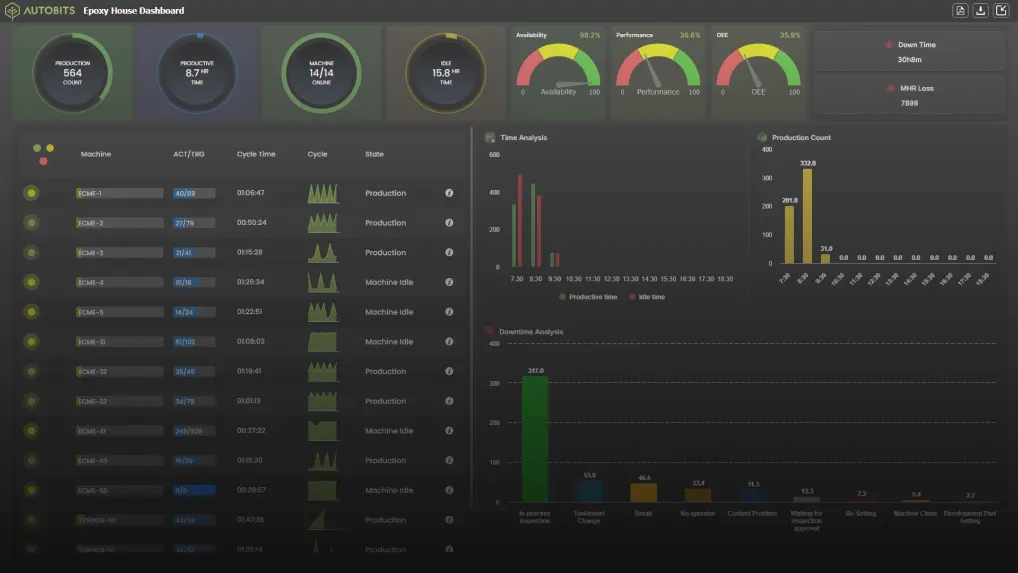
Q5. How does machine monitoring software reduce CNC machine running costs?
Machine monitoring software reduces CNC running costs in three specific ways. First, it identifies and quantifies idle time, which allows management to address the root causes of machine stoppages and increase productive spindle hours per shift. Second, it detects feed rate overrides where operators run machines below programmed speeds, which reduces output per hour. Third, it provides early warning signals of mechanical issues through spindle load trend analysis, allowing maintenance teams to intervene before a breakdown causes expensive emergency repairs. A 10 percent improvement in spindle utilization on a ₹40 lakh VMC running two shifts typically represents ₹8 lakh to ₹15 lakh in additional annual output value.
Read More Industry 5.0 & 4.0 Blogs
- What Is a CNC Machine
- How CNC Machines Work: A Detailed Guide
- Types of CNC Machines
- Top CNC Machine Manufacturers in India
- Top CNC Machine Manufacturers in the USA
- Top CNC Grinding Machine Manufacturers in India
- Top Lathe CNC Machine Manufacturers in India
- ROI of Machine Monitoring Software
- Improving Productivity with CNC Machine
- What Is OEE in Manufacturing