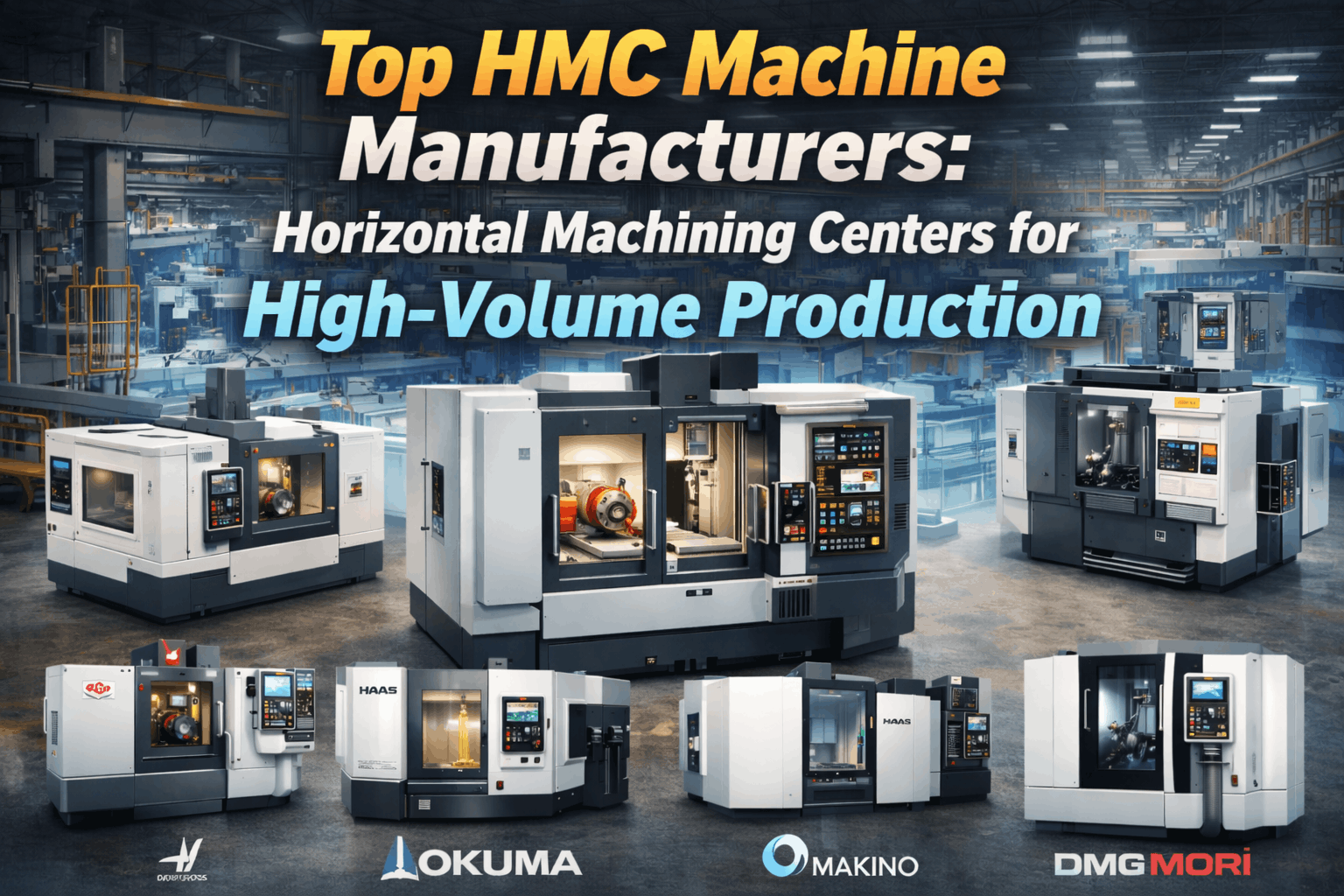
| AEO Snippet (for Featured Snippets and AI Overviews) The top HMC machine manufacturers in India include Mazak, Makino, DMG MORI, BFW, Okuma, Toyoda, and Doosan. Horizontal machining centers are used for high-volume automotive, aerospace, and heavy engineering production. In India, HMC prices range from ₹80 lakh to ₹5 crore, depending on pallet size, spindle power, and axis configuration. |
Why Horizontal Machining Centers Are the Backbone of High-Volume Indian Manufacturing
Walk through any Tier 1 automotive plant in Pune, Chennai, or Sanand, and you will find rows of horizontal machining centers running around the clock. HMCs are not the most visible machines in Indian manufacturing, but they are often the most productive.
While VMCs dominate small and medium shops, HMCs are the machine of choice wherever volume, chip removal, and multi-face machining in a single setup are critical. The automotive and heavy engineering sectors in India have driven HMC adoption aggressively over the past decade.
This guide covers the top HMC machine manufacturers serving the Indian market, the technical specifications that matter, realistic price ranges, and what to evaluate before placing an order.
What Is a Horizontal Machining Center?
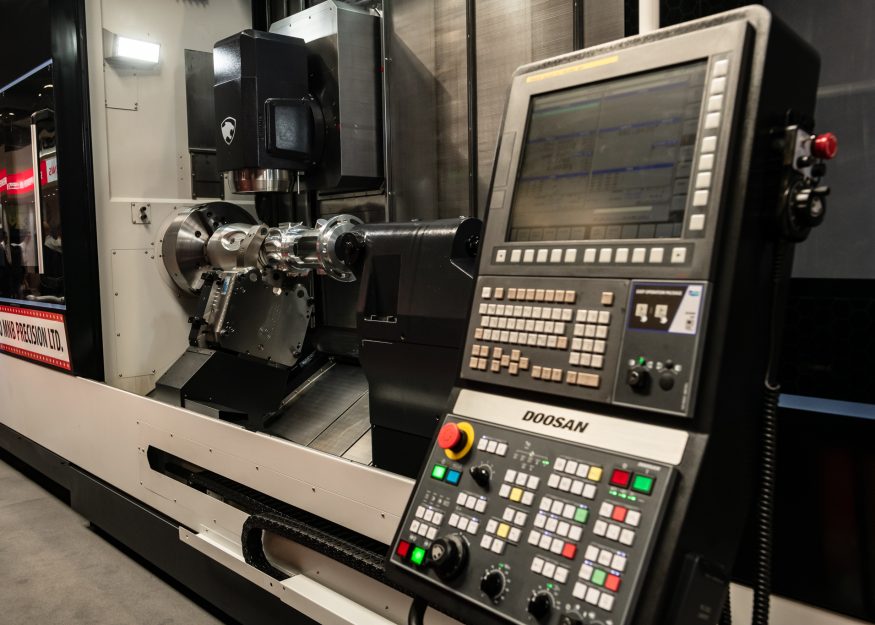
A horizontal machining center (HMC) is a CNC machine tool where the spindle axis is oriented horizontally, parallel to the ground. Unlike a VMC, where the spindle points downward, an HMC spindle points sideways at the workpiece.
This horizontal orientation creates a fundamental advantage: chips fall away from the cutting zone by gravity rather than accumulating on the workpiece. In heavy material removal, chip management directly affects surface finish, tool life, and thermal stability of the part.
HMCs almost always include a rotary pallet system. The machine has two pallets: one in the cutting zone and one in the loading station. While the machine cuts parts on the first pallet, an operator loads the next batch on the second pallet. When cutting is complete, the pallets rotate automatically, and cutting resumes without a manual changeover pause. This dramatically increases spindle utilization.
Key HMC advantages over VMCs:
- Better chip evacuation in heavy cutting operations
- 4-face machining in a single setup using the built-in rotary table
- Higher spindle utilization through dual pallet operation
- Better thermal stability for long-run precision work
- Superior performance in cast iron, steel, and heavy alloy machining
HMC vs VMC: When to Choose Each
| Factor | HMC | VMC |
| Production Volume | High volume, dedicated production | Low to medium volume, flexible production |
| Part Complexity | Multi-face parts in a single setup | Typically, one or two face machining |
| Chip Management | Superior (gravity chip fall) | Requires active chip removal |
| Floor Space per Spindle | Higher (pallets add footprint) | Lower footprint |
| Initial Investment | Higher (₹80 lakh to ₹5 crore) | Lower (₹22 lakh to ₹1.5 crore) |
| Best Application | Automotive engine blocks, gearbox cases, hydraulic bodies | Dies, molds, fixtures, and general parts |
| Spindle Utilization | Very high with dual pallet | Depends on setup efficiency |
| Operator Skill Level | Moderate to high | Entry to moderate |
How We Selected These Manufacturers
Each manufacturer was evaluated on:
- Machine engineering quality: Bed rigidity, spindle bearing quality, thermal compensation, and actual accuracy in Indian plant conditions.
- Pallet and automation options: Standard pallet sizes, multi-pallet pool availability, and robotic integration readiness.
- Controller options: Fanuc, Siemens, Mitsubishi, or proprietary control compatibility.
- Service network in India: Number of field engineers, response time, and spare parts availability from local stock.
- Industry reference base: Verified installations in Indian automotive, aerospace, and heavy engineering plants.
- Total cost of ownership: Price relative to productivity delivered over a 10-year operating horizon.
Top 10 HMC Machine Manufacturers in India
Mazak (Yamazaki Mazak India)
Headquarters: Minokamo, Japan India Operations: Manufacturing facility in Pune HMC Range: HCN series, HCR series, i-150, and i-200 horizontal machining centers
Mazak is the strongest presence in India’s HMC market for one key reason: they manufacture locally in Pune. This means shorter delivery lead times, locally stocked spare parts, and faster field service response compared to fully imported machines.
Their HCN series horizontal machining centers are widely installed in Indian automotive plants for engine components, gearbox housings, and hydraulic bodies. The HCN 5000 and HCN 6800 cover pallet sizes from 500 mm to 800 mm and are designed for dedicated high-volume production.
Mazak’s iSMART Factory capabilities allow machine data to be fed directly to production management systems via MTConnect and OPC-UA. This makes Mazak HMCs among the easiest to integrate with machine monitoring platforms.
Best for: Automotive OEM plants, Tier 1 engine and gearbox production, aerospace structural components.
Makino India
Headquarters: Narita, Japan India Operations: Bengaluru HMC Range: a-series, d-series, DA300 through DA800
Makino’s horizontal machining centers are positioned at the precision and speed end of the market. Their a-series HMCs are recognized globally for exceptional thermal stability, high-speed spindles, and sub-micron accuracy over long production runs.
In India, Makino serves the aerospace, die and mold, and high-precision automotive sectors. Their a51nx and a61nx are among the most commonly specified HMCs in Indian aerospace manufacturing.
Makino’s Hyper-i control, based on a Windows platform with touchscreen interface, provides production data reporting capabilities that integrate with external monitoring systems.
Best for: Aerospace components, precision automotive, medical implant machining, and complex die and mold.
DMG MORI India
Headquarters: Tokyo, Japan, and Bielefeld, Germany. India Operations: Bengaluru, with Technology Center HMC Range: NHX series, NH series, NHC series
DMG MORI’s NHX series horizontal machining centers represent the global benchmark in their class. The NHX 4000, NHX 5000, and NHX 6300 cover pallet sizes from 400 mm to 630 mm and are designed for 24-hour unmanned operation with multi-pallet pool systems.
What sets DMG MORI apart is its CELOS control interface. CELOS connects machine operation with production planning, tool management, and shop floor monitoring through a unified touchscreen interface. For plants building a digital manufacturing infrastructure, this native connectivity is a significant advantage.
DMG MORI India operates a Technology Excellence Center in Bengaluru, where customers can validate their process before machine purchase.
Best for: Aerospace structural parts, automotive engine components, defense manufacturing, and lights-out production.
Okuma India
Headquarters: Oguchi, Japan
India Operations: Delhi NCR
HMC Range: MA series, MB series, MU series multi-axis
Okuma’s horizontal machining centers use their proprietary OSP-P300 control, which delivers thermal compensation and vibration-damping capabilities that are built into the control firmware. The Thermo-Friendly Concept in Okuma machines minimizes dimensional changes caused by thermal growth, which is critical in high-precision automotive and aerospace work.
The MA-600HB and MB-800H are Okuma’s strongest sellers in India for automotive block machining and large part aerospace work. Okuma machines have a strong installed base in Tier 1 automotive plants in Pune, Chennai, and Manesar.
Best for: High-volume automotive block and case machining, large aerospace structural components.
Toyoda (JTEKT Machinery India)
Headquarters: Aichi, Japan
India Operations: Delhi NCR (Gurgaon)
HMC Range: FH series, FHN series horizontal machining centers
Toyoda is a name that carries significant respect in Indian automotive manufacturing. Their FH series HMCs are workhorses designed for continuous production of engine blocks, cylinder heads, and transmission cases.
Toyoda’s patent-pending thermal-stabilized spindle bearing design and high-rigidity column construction make their machines particularly suited for Indian conditions, where ambient temperature variation can affect dimensional accuracy.
Best for: Automotive OEM dedicated production lines, cylinder block and head machining, transmission components.
Doosan Machine Tools (DN Solutions)
Headquarters: Changwon, South Korea India Operations: Through authorized distributors in Pune, Delhi, Chennai HMC Range: HP 4000 to HP 6300 series, DHM series
Doosan, now rebranded as DN Solutions, offers a strong value proposition in the mid-to-premium HMC segment. Their HP series horizontal machining centers deliver competitive spindle power, axis speed, and pallet capacity at pricing that is typically 15 to 25 percent below equivalent Japanese models.
The Doosan FANUC-controlled HP series is well-proven in Indian automotive plants, particularly for gearbox and hydraulic component production. Local service coverage has improved significantly through their expanded distributor network.
Best for: Automotive Tier 1 and Tier 2 manufacturers, general engineering plants looking for high performance at competitive pricing.
Heller Machine Tools (India)
Headquarters: Nürtingen, Germany India Operations: Through authorized service partners in Pune and Chennai HMC Range: H series, HF series 4-axis and 5-axis HMCs
Heller is one of the most specified HMC brands for automotive OEM dedicated production lines globally and in India. Their H 2000 and H 4000 series are commonly found in automotive plants producing engine components.
Heller HMCs are engineered for maximum metal removal rates. Their direct-drive spindle technology and thermosymmetric machine structure deliver high productivity with long-term accuracy, even in 3-shift continuous operation.
Best for: Automotive OEM dedicated production lines, high-volume aluminum machining, engine and powertrain components.
Chiron Group (India)
Headquarters: Tuttlingen, Germany India Operations: Through distributors and service partners HMC Range: Mill 2000, DZ series, FZ series machining centers
Chiron is a specialist in high-speed machining and machining of aluminum and light alloys. Their DZ series twin-spindle horizontal machining centers effectively double productivity per floor space compared to conventional single-spindle HMCs.
In India, Chiron machines are used in the EV component manufacturing sector, automotive aluminum structural parts, and precision medical device components.
Best for: Aluminum machining, EV component production, high-speed precision work.
Kitamura Machinery (India)
Headquarters: Toyama, Japan India Operations: Through specialized distributors HMC Range: Mycenter-HX series, HX series horizontal machining centers
Kitamura is a premium Japanese brand with a loyal following in Indian aerospace and die-mold facilities. Their Mycenter-HX series is particularly known for surface finish quality and geometric accuracy that meets aerospace quality requirements without extended machine qualification time.
Best for: Aerospace component machining, high-precision die and mold work, and medical device production.
BFW (Bharat Fritz Werner)
Headquarters: Bengaluru, Karnataka HMC Range: Select horizontal machining center configurations alongside their VMC range
BFW’s portfolio includes horizontal machining center configurations for Indian manufacturing requirements. As India’s largest domestic CNC machine manufacturer, BFW represents the strongest after-sales network in India for buyers who prioritize local support and Indian-made equipment.
For plants in Tier 2 cities or regions where imported machine service response is slow, BFW provides a practical and reliable HMC alternative with domestic supply chain advantages.
Best for: General engineering, Tier 2 city manufacturers, Indian market-specific requirements, government-aligned procurement.
HMC Machine Price Range in India (2026)
| HMC Category | Pallet Size | Price Range (Approx.) | Typical Application |
| Entry to Mid Range | 400 to 500 mm | ₹80 lakh to ₹1.5 crore | General engineering, small automotive parts |
| Mid Range | 500 to 630 mm | ₹1.5 crore to ₹2.5 crore | Automotive components, gearbox cases |
| Premium | 630 to 800 mm | ₹2.5 crore to ₹4 crore | Engine blocks, large aerospace parts |
| Multi-Pallet Systems | 630 mm and above | ₹4 crore to ₹8 crore | Dedicated OEM production lines |
Prices are indicative and vary based on controller selection, pallet pool configuration, automation integration, and import duties. Request itemized quotations including foundation work, coolant system, chip conveyor, and installation.
Key Specifications to Evaluate in an HMC
Pallet Size
Pallet size determines what workpiece dimensions you can machine. Standard pallet sizes in India range from 400 mm to 800 mm square. Always check the maximum workpiece diameter allowed over the pallet and the maximum workpiece height that clears the pallet changer mechanism.
Spindle Power and Torque
HMCs for cast iron and steel machining need high torque at low to mid spindle speeds. Aluminum machining requires high RPM with moderate torque. A 22 kW to 37 kW spindle is standard in mid-range production HMCs.
Table Indexing Resolution
The built-in rotary table should index in 1-degree increments at a minimum for general work. Precision 4-axis HMCs with 0.001-degree resolution are required for complex angular features.
Axis Rapid Traverse Speed
60 m/min rapid traverse is the current standard for productive HMCs. Lower rapid traverse on older or budget machines creates idle time that adds up significantly across multi-shift production.
Automatic Pallet Changer (APC) Cycle Time
The APC exchanges pallets between the cutting zone and the loading station. Faster APC cycle time (under 10 seconds is good, under 6 seconds is excellent) reduces machine idle time between batches.
Chip Conveyor and Coolant System
HMCs generate significantly more chips than VMCs in heavy cutting. Evaluate the chip conveyor capacity, coolant flow rate, and through-spindle coolant pressure. Through-spindle coolant at 70 bar is preferred for deep hole drilling in automotive parts.
How Machine Monitoring Improves HMC Productivity
HMCs are expensive assets. A single horizontal machining center represents ₹1.5 crore to ₹4 crore in capital. Every hour that the machine is idle, running below the programmed feed rate, or waiting for an operator response to an alarm is a measurable financial loss.
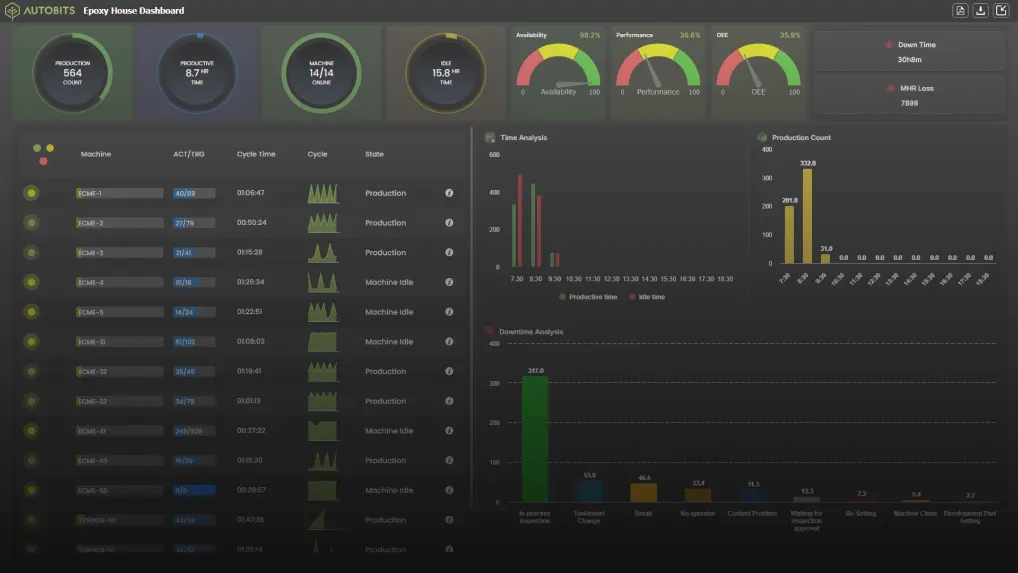
Machine monitoring software gives HMC operators and plant managers complete real-time visibility into:
- Spindle utilization per machine per shift
- Pallet change cycle efficiency and idle time between batches
- Feed rate override detection (operators reducing feed rate below programmed value)
- Alarm frequency and duration by machine
- OEE calculation broken into availability, performance, and quality losses
- Automatic downtime logging without paper-based records
A common finding when Indian plants first deploy machine monitoring on their HMC lines: actual spindle cutting time is 35 to 55 percent of available shift time. The remaining time is split between setup, tool changes, material waiting, operator interventions, and unresolved alarms.
Reducing that idle time by even 8 to 10 percentage points on a machine running two shifts translates to significant additional parts output per month without any capital investment beyond the monitoring software.
Machine monitoring also provides the data foundation for predictive maintenance. By tracking spindle load trends, vibration patterns, and alarm frequency over time, maintenance teams can identify deteriorating machine conditions before they cause a breakdown.

FAQ: HMC Machine Manufacturers in India
What is the difference between an HMC and a VMC machine?
A VMC has a vertical spindle pointing downward. An HMC has a horizontal spindle pointing sideways. HMCs are better for high-volume production because chips fall away from the cutting zone by gravity, they include dual pallet systems that keep the spindle cutting while the operator loads the next batch, and their rotary table allows four-face machining in a single setup. VMCs are more versatile and cost less, making them better suited for low-to-medium volume work.
Which HMC manufacturer has the best service network in India?
Mazak has the strongest combination of local manufacturing in Pune, regional service offices, and spare parts availability in India. For domestic brand support, BFW offers the widest coverage across Indian states. For premium Japanese and German brands, service quality varies significantly by city. Always ask for the number of service engineers within your region and the average response time before purchasing.
Is an HMC worth the higher investment over a VMC for automotive production?
Yes, for dedicated high-volume automotive component production. An HMC’s dual pallet system increases spindle utilization by 20 to 35 percent compared to a VMC doing the same work. Over a three-shift operation producing thousands of parts per month, this productivity difference offsets the higher machine cost within 18 to 36 months in most cases. HMCs also reduce fixturing costs by machining multiple faces in one setup.
What coolant pressure is required for HMC machining of automotive castings?
For standard milling and boring operations on automotive castings, 20 to 40 bar through-spindle coolant is adequate. For deep-hole drilling in engine blocks and cylinder heads, 70 bar through-spindle coolant is preferred to ensure chip evacuation from deep bores. Always confirm the coolant pressure specification and whether the coolant pump is included or optional in the base machine price.
Can machine monitoring software connect to HMC machines from all major manufacturers?
Yes. All major HMC brands listed in this guide use Fanuc, Siemens, Mitsubishi, or proprietary controllers that support standard data interfaces. MTConnect and OPC UA are natively supported on Mazak, DMG MORI, Okuma, and Makino machines. For Fanuc-controlled HMCs from other manufacturers, the Fanuc FOCAS protocol provides comprehensive access to machine data. An IIoT gateway bridges older machines without network interfaces.
Read more:
- Top CNC Machine Manufacturers in India: A Detailed Overview
- Top VMC Machine Manufacturers in India
- How CNC Machines Work: A Detailed Guide
- Types of CNC Machines
- What Is OEE in Manufacturing
- Real-Time Production Monitoring Software
- Strategies to Improve OEE
- Machine Condition Monitoring Guide
- Improving Productivity with a CNC Machine
- CNC Machine Monitoring Data Collection Methods