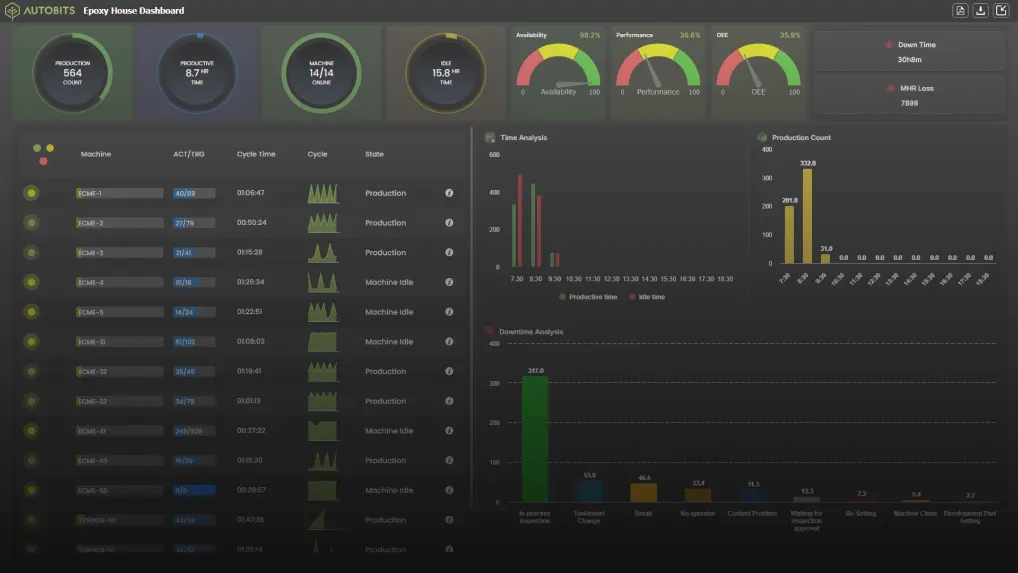
When you are evaluating machine monitoring software for your US manufacturing operation, the stakes are high. A platform that does not fit your shop floor infrastructure, your ERP system, or your team’s capacity to adopt new tools will cost you more than the subscription fee. You will lose time, compromise data integrity, and slow the efficiency gains you were trying to achieve in the first place.
This comparison was built to give Manufacturing IT Directors and Plant Managers a structured, criteria-driven view of four platforms that frequently appear in procurement conversations across US discrete manufacturing: MachineMetrics, Datanomix, Scytec DataXchange, and Autobits Labs. Each platform is examined across eight criteria that matter most to decision-makers at SMB and mid-market manufacturers. No vendor paid for placement in this comparison. The intent is to help you match the right tool to your operational reality.
How We Built This Comparison
This comparison was constructed using publicly available vendor documentation, product pages, third-party software review platforms, and verified user feedback sources. We did not use vendor-supplied marketing materials as the sole basis for any claim. Where pricing data was publicly available and verified through multiple sources, it is cited directly. Where vendors do not publish pricing, that is noted as a relevant data point in itself.
The eight criteria used in this comparison are derived from what US manufacturers at the SMB and mid-market level consistently cite as procurement priorities: deployment flexibility, controller compatibility, ERP integration depth, pricing structure, offline data handling, support model, multi-site capabilities, and readiness for job shops specifically. Each criterion is explained in context before the scorecard is applied.
The 8 Criteria That Matter for US Manufacturers
1. Deployment Options
Cloud-only platforms are faster to implement but require stable internet connectivity at all times. On-premise or hybrid deployments give manufacturers with compliance requirements or intermittent connectivity more control over their data. For many shops in rural manufacturing corridors across Ohio, Michigan, and Indiana, deployment flexibility is not a preference but a necessity.
2. Controller Compatibility
A machine monitoring platform is only as useful as the machines it can connect to. US shops run a wide variety of CNC controllers from Fanuc, Haas, Okuma, Mazak, Heidenhain, and Siemens, often across mixed-vintage fleets. A platform that cannot connect to your existing equipment requires costly retrofitting or forces premature machine replacement, neither of which aligns with capital planning realities at SMB manufacturers.
3. ERP Integration
Production data held in isolation from your ERP creates a two-system problem. Scheduling, job costing, labor tracking, and on-time delivery visibility all depend on the machine floor and the ERP speaking the same language. Platforms with pre-built ERP connectors reduce implementation risk and shorten time to value significantly.
4. Pricing Model and Transparency
Pricing opacity is a well-documented problem in the machine monitoring software market. Most enterprise-tier platforms require a demo call before any pricing information is shared. This creates friction during budget approval and makes total cost of ownership difficult to calculate in advance. Platforms that publish at least a starting price or per-machine rate give procurement teams a more honest starting point.
5. Offline Data Handling
Internet connectivity on the shop floor cannot be assumed to be constant. Whether caused by infrastructure gaps, planned maintenance, or network disruptions, data loss during offline periods directly compromises the integrity of OEE calculations, downtime tracking, and compliance reporting. Platforms that retain data locally and sync when connectivity is restored are operationally more reliable.
6. AI and Predictive Analytics
Basic machine monitoring tells you what happened. Predictive analytics tells you what is about to happen and gives your team time to act. The quality, specificity, and integration of AI features varies substantially across platforms. Anomaly detection, tool wear prediction, and cycle time deviation alerts all fall into this category.
7. Multi-Site and Scalability
A platform that works well for a single facility but creates complexity or cost at the point of expansion is a constraint on growth. For manufacturers with multiple plants across US states, or those anticipating expansion, the architectural scalability of the platform matters as much as its current feature set.
8. Support, Onboarding, and SMB Fit
Implementation support quality has a direct impact on adoption speed and long-term ROI. For manufacturers without dedicated IT staff, the availability of structured onboarding, guided coaching programs, and accessible technical support determines whether the platform delivers its promised outcomes or sits underutilized.
Side-by-Side Feature Scorecard
The table below summarizes how each platform performs across the eight evaluation criteria. All data points are sourced from publicly available vendor documentation and verified third-party platforms.
| Evaluation Criteria | MachineMetrics | Datanomix | Scytec DataXchange | Autobits Labs |
|---|---|---|---|---|
| Deployment Options | Cloud only | Cloud only | Cloud and On-Premise | Cloud and On-Premise |
| Pricing Model | Custom (per machine, subscription) | Per machine per year | Per machine per month (from $52) | Custom (contact for quote) |
| ERP Integration | 20+ pre-built connectors | Universal ERP Connector | RESTful API, CSV, VB Script | ERP and MES integration supported |
| Controller Compatibility | MTConnect, Fanuc, OPC-UA, Modbus, Ethernet IP | G-Code based (Fanuc, Haas, Mazak, Okuma) | MTConnect, Fanuc FOCAS, OPC-UA, Haas, Heidenhain, Mazak, Okuma, Siemens | Wi-Fi, Bluetooth, Ethernet, MTConnect, OPC-UA |
| Offline Data Retention | Not specified | Not specified | Local data retention during connectivity loss | Onboard gateway storage; full data integrity offline |
| Machine Interlocking | Not available | Not available | Not available | Available; locks machine at production target |
| AI and Predictive Analytics | AI-driven alerts and anomaly detection | TMAC AI, FactoryMate AI | Not a primary feature | AI reporting, predictive maintenance alerts |
| OEE Monitoring | Yes | Yes (with benchmark evolution) | Yes (unlimited reporting) | Yes (up to 25% OEE improvement claimed) |
| Multi-Site Support | Yes | Yes | Yes (multi-plant across time zones) | Yes |
| Mobile App | Yes (Android and iOS) | Yes (iOS and Android) | Yes (iOS and Android) | Yes (50+ parameters trackable via mobile) |
| Support for Legacy Machines | Yes (universal connectivity) | Limited (G-Code based primary) | Yes (SRC module for analog and manual machines) | Yes (multiple connectivity types including Bluetooth) |
| Primary Market Focus | Mid-market to enterprise discrete manufacturers | Precision manufacturers and job shops | All sizes: SMB to enterprise | SMB to mid-market manufacturers globally |
| What is the best machine monitoring software for US manufacturers? The best machine monitoring software for US manufacturers depends on shop size and operational requirements. MachineMetrics suits mid-market to enterprise discrete manufacturers with complex ERP needs. Datanomix targets precision CNC job shops with its G-Code-based intelligence. Scytec DataXchange offers the most transparent per-machine pricing, starting at $52 per machine per month, and supports both cloud and on-premise deployment. Autobits Labs differentiates through machine interlocking, offline data retention via onboard gateway storage, and multi-connectivity support across Wi-Fi, Bluetooth, and Ethernet. Each platform serves a distinct operational profile. |
Integration and Controller Compatibility
MachineMetrics
MachineMetrics supports a wide range of industrial protocols including MTConnect, Fanuc, OPC-UA, UMATI, Modbus, and Ethernet IP, giving it strong connectivity across modern CNC equipment. On the ERP side, the platform offers more than 20 pre-built connectors including SAP ERP, Oracle Fusion Cloud ERP, Microsoft Dynamics 365, Epicor Kinetic, Infor VISUAL, Sage X3, Plex, and JobBOSS2, among others. This depth of native ERP integration is one of MachineMetrics’ clearest advantages for manufacturers already running complex enterprise software stacks.
Datanomix
Datanomix takes a G-Code first approach to machine connectivity. Its platform builds performance benchmarks from actual G-Code runs, tracking cutting time, probing time, touch time, and planned stoppages per cycle with precision. In October 2025, Datanomix launched its Universal ERP Connector, which supports both cloud-based and on-premise ERP systems including SAP, Epicor, NetSuite, Infor, JobBOSS, GlobalShop, and Plex. The setup process requires selecting an ERP, entering credentials, and pressing connect with no custom integration or middleware required. The company also announced a direct integration with Fulcrum, a cloud ERP built specifically for manufacturers, in November 2025.
Scytec DataXchange
Scytec DataXchange supports an extensive range of controller protocols including MTConnect, Fanuc FOCAS, OPC-UA, Modbus TCP, and direct proprietary protocols for Fanuc, Haas, Heidenhain, Mazak, Okuma, and Siemens machines. For older or manual equipment, the DataXchange SRC module uses a low-cost PLC-based approach to capture data via voltage signals, current flow, and presence sensors. ERP integration is available through RESTful API, VB Scripts, or CSV and database table connectivity. This makes DataXchange capable of integrating with virtually any ERP system, though it requires more implementation effort compared to platforms with pre-built connectors.
Autobits Labs
Autobits Labs supports connectivity via Wi-Fi, Bluetooth, Ethernet, and wireless connections, along with standard industrial protocols including MTConnect and OPC-UA. The platform’s IoT gateway collects data directly from controllers regardless of brand, enabling unified visibility across mixed-machine fleets. Autobits supports integration with ERP and MES systems. The platform’s multi-connectivity approach is particularly well-suited to older facilities where infrastructure modernization is incremental rather than immediate.
Pricing and Contract Flexibility
MachineMetrics
MachineMetrics operates on a true SaaS subscription model with volume-based per-machine pricing. The platform offers Professional and Enterprise tiers, both with custom pricing determined by machine count and deployment scope. A free trial is available. Pricing is not published publicly. All plans include unlimited remote technical support, customer onboarding, product training, and a designated support contact. The volume-based structure means per-machine costs decrease as machine count grows, which benefits larger deployments.
Datanomix
Datanomix prices its platform on a per machine per year basis, with an unlimited number of user accounts at no additional cost. ERP integration through the Universal ERP Connector does not require consultants, coding, or custom middleware. Specific pricing is not published publicly and requires a demo engagement to obtain a quote.
Scytec DataXchange
Scytec DataXchange publishes the most transparent pricing structure in this comparison. The platform operates on a per-machine per-month basis with a one-time account activation fee. Published starting pricing from third-party sources indicates the Bronze tier begins at approximately $50 to $52 per machine per month on the Commercial Cloud, with a one-time activation fee. Volume discounts begin at 10 machines and increase with machine count. Annual and multi-year agreements provide additional discounts. The On-Premise option starts at approximately $1,000 per machine as a one-time fee at the Bronze license level. Multiple license tiers, Bronze, Silver, Gold, and Platinum, determine the depth of data collection available.
Autobits Labs
Autobits Labs does not publish a standard pricing schedule on its website. Pricing is determined through direct engagement based on machine count, deployment type, and feature requirements. The platform offers both cloud-based and on-premise deployment options. For US manufacturers evaluating budget impact, requesting a direct quote from Autobits is the required next step.
Support and Onboarding
MachineMetrics
MachineMetrics includes customer onboarding, product training, unlimited remote technical support, and a designated customer support point of contact in all subscription tiers. Training is available through documentation, live online sessions, webinars, in-person sessions, and videos. The platform also supports English as its operating language and maintains mobile applications for Android and iOS.
Datanomix
Datanomix differentiates on onboarding through its Kick-Ass Coaching program, a structured continuous improvement coaching service built around customer-specific business goals. The program provides guided workflow adoption through purpose-built Product Tracks. The platform’s Playbooks feature sequences the right data views throughout the day, from morning huddles to end-of-day reviews, reducing reliance on user-initiated navigation and supporting adoption by operators who are not data-trained. Datanomix is headquartered in Nashua, New Hampshire, and serves manufacturers across the United States.
Scytec DataXchange
Scytec DataXchange provides support via phone and online channels, with training available through documentation, live online sessions, webinars, and in-person options. The platform offers English and Spanish language support, which is a practical advantage for US facilities with bilingual workforces. DataXchange is designed with implementation simplicity as a priority and does not require dedicated IT staff for setup. Licenses are fully transferable between machines and across facilities.
Autobits Labs
Autobits Labs provides onboarding and implementation support directly. The platform’s closed-loop connectivity design is intended to reduce integration complexity. Autobits operates with a focus on Industrial IoT implementation for manufacturers and describes a setup process that can be operational within days for compatible equipment.
Which Platform Wins for Job Shops
Job shops operating high-mix low-volume production environments have specific requirements that general-purpose machine monitoring platforms often do not address with adequate depth. The critical needs in a job shop context are: per-job machine time visibility, rapid changeover tracking, cycle time benchmarking per part number, and a lean IT infrastructure that does not require a dedicated technology team to maintain.
Datanomix is explicitly built for this environment. Its G-Code Cloud and TMAC AI features build performance benchmarks from actual machining data on a per-job basis. The Time on Tap metric specifically addresses the common shop floor wastes of delayed starts, extended breaks, and idle periods between shifts. The Machine HUD provides operators with time remaining per part and upcoming tool change schedules without requiring manual lookups.
Scytec DataXchange is also well-positioned for job shops through its transparent per-machine pricing, no minimum machine count requirement, and support for manual and legacy machines alongside modern CNC controllers. For job shops with 5 to 30 machines and no dedicated IT staff, the DataXchange Bronze tier provides a low-risk entry point with minimal setup overhead.
Autobits Labs addresses the job shop context through its machine interlocking feature, which prevents overproduction once a production target is reached. For high-mix operations where each job has a specific quantity target, this capability adds a layer of production discipline that most competing platforms do not offer. The offline data retention via onboard gateway storage also benefits job shops where connectivity is not guaranteed.
MachineMetrics serves job shops but is optimized for mid-market and enterprise operations where ERP integration depth and advanced MES capabilities are the primary requirements.
Which Platform Wins for Mid-Market Multi-Plant Manufacturers
For manufacturers operating two or more production sites across US states, the architecture of the monitoring platform must support cross-plant visibility, centralized reporting, and license portability without creating separate siloed deployments.
MachineMetrics is the strongest platform in this category. Its cloud infrastructure supports global multi-plant deployments, and its ERP integration depth allows production data from multiple sites to be synchronized with enterprise systems without custom middleware. The platform’s modular MES capabilities, including work order management, intelligent scheduling, and OEE analytics, make it suitable for operations where machine monitoring is one component of a broader digital transformation initiative.
Scytec DataXchange also performs well in multi-plant deployments. The platform’s distributed architecture supports comparison of machine utilization, downtime, and OEE reports across plants and time zones. Licenses are transferable between machines and facilities, and the GovCloud deployment option is available for manufacturers with federal contracting or compliance requirements. For mid-market manufacturers who need multi-site visibility at a predictable per-machine cost, DataXchange is a credible option.
Datanomix and Autobits Labs both support multi-site deployments, though their primary design focus is shop-level production intelligence rather than enterprise-wide platform architecture.
Verdict: Which Platform Should You Choose
Choose MachineMetrics if
- You operate a mid-market or enterprise discrete manufacturing facility
- Deep pre-built ERP integration with platforms like SAP, Oracle, or Epicor is a procurement requirement
- You need a modular MES with work order management and intelligent scheduling in addition to machine monitoring
- Your IT team has the capacity to manage a sophisticated platform and leverage open API capabilities
Choose Datanomix if
- Your shop runs high-mix low-volume CNC machining with complex G-Code programs
- Per-job cycle time benchmarking and production intelligence are higher priorities than broad ERP connectivity
- You want a coaching-led adoption model with structured guidance for your team
- You are a precision manufacturer in the US looking for AI features that fit directly into shop floor workflows
Choose Scytec DataXchange if
- Pricing transparency and predictable per-machine costs are priorities in your budget approval process
- You need both cloud and on-premise deployment options with no required minimum machine count
- Your facility includes manual machines, legacy equipment, or non-CNC assets that need to be included in OEE reporting
- You want a scalable platform that works equally well for a 10-machine shop and a multi-plant enterprise
Choose Autobits Labs if
- Machine interlocking for production target enforcement is a requirement in your shop floor operations
- Offline data retention via onboard gateway storage is critical due to connectivity constraints at your facility
- You need multi-connectivity support across Wi-Fi, Bluetooth, and Ethernet for a mixed-vintage machine fleet
- You are looking for a platform that monitors 50 or more machine parameters via mobile and supports predictive maintenance alerts
- You want an IIoT platform with Digital Twin capabilities and closed-loop machine connectivity that guarantees zero data loss
| Ready to see Autobits in action?Schedule a demo with the Autobits Labs team to see how the platform connects to your existing machines, what parameters it monitors, and how it compares to your current monitoring approach. Book your demo at autobitslabs.com. |
Frequently Asked Questions
What is the best machine monitoring software for US manufacturers in 2026?
There is no single best platform across all use cases. MachineMetrics is strongest for mid-market to enterprise discrete manufacturers who need deep ERP integration and MES capabilities. Datanomix is best suited to precision CNC job shops focused on per-job production intelligence. Scytec DataXchange offers the most transparent pricing and the broadest machine compatibility range. Autobits Labs differentiates through machine interlocking, offline data integrity, and multi-connectivity support. The right choice depends on your machine mix, IT capacity, ERP environment, and operational priorities.
How does Autobits compare to MachineMetrics?
Both platforms support real-time machine monitoring, OEE tracking, and predictive maintenance. MachineMetrics offers more than 20 pre-built ERP connectors and a broader MES feature set optimized for large-scale enterprise deployments. Autobits Labs differentiates through machine interlocking, which prevents overproduction by locking machines when production targets are met, onboard gateway storage that ensures zero data loss during connectivity outages, and support for monitoring more than 50 machine parameters via mobile. Autobits also supports multi-connectivity options, including Wi-Fi, Bluetooth, and Ethernet, giving it stronger flexibility for mixed-vintage fleets.
What machine monitoring software works without dedicated IT staff?
Scytec DataXchange and Datanomix are both designed with minimal IT dependency in mind. DataXchange’s Commercial Cloud deployment eliminates the need for on-site server management and its implementation process does not require specialized IT knowledge. Datanomix’s Universal ERP Connector setup requires selecting an ERP, entering credentials, and pressing connect with no custom integration. Autobits Labs also supports rapid deployment through its IoT gateway-based connectivity approach.
Does machine monitoring software work with older CNC machines?
Yes. Scytec DataXchange uses its SRC module to collect data from older and manual machines via voltage signals, current sensors, and proximity sensors. MachineMetrics supports legacy machine connectivity through edge gateways. Autobits Labs connects to machines of any age through multiple connectivity types including Bluetooth and Ethernet, with the gateway handling data capture. Datanomix’s approach is primarily G-Code-based and works best with machines that execute standard CNC programs.
What is the most affordable machine monitoring software?
Scytec DataXchange publishes the most accessible entry-level pricing, with the Commercial Cloud Bronze tier starting at approximately $52 per machine per month with a one-time account activation fee. Volume discounts begin at 10 machines. Other platforms including MachineMetrics, Datanomix, and Autobits Labs require a direct engagement to receive pricing. Affordability also depends on total cost of ownership including implementation, training, and ongoing support costs, not just the subscription fee.
Which machine monitoring platforms support multi-plant US manufacturing operations?
MachineMetrics and Scytec DataXchange both have documented multi-plant capabilities with cross-facility reporting and license portability. MachineMetrics is designed for global enterprise deployments. Scytec DataXchange supports multi-plant comparison of machine utilization, OEE, and downtime across time zones. Datanomix and Autobits Labs both support multi-site deployments and are adding capabilities in this area as their platforms evolve.
Conclusion
The machine monitoring software market in 2026 offers US manufacturers more capable and accessible options than at any previous point. The four platforms reviewed here represent meaningfully different approaches to a common goal: turning shop floor machine data into decisions that improve uptime, throughput, and profitability.
MachineMetrics leads on enterprise ERP connectivity and MES depth. Datanomix leads on per-job G-Code intelligence and coaching-led adoption for precision shops. Scytec DataXchange leads on pricing transparency and deployment flexibility. Autobits Labs leads on machine interlocking, offline data integrity, and multi-connectivity support for manufacturers who need a platform that works reliably across diverse and older machine fleets.
The decision is not which platform is objectively superior. The decision is which platform fits your machines, your team, your ERP environment, and your budget. Use this comparison as a structured starting point and validate each platform against your specific shop floor requirements in a live demo.
| Next Step for Autobits Evaluation: Contact the Autobits Labs team to discuss your machine mix, connectivity requirements, and OEE improvement goals. Request a demo at autobitslabs.com to see the platform working with equipment similar to yours. |