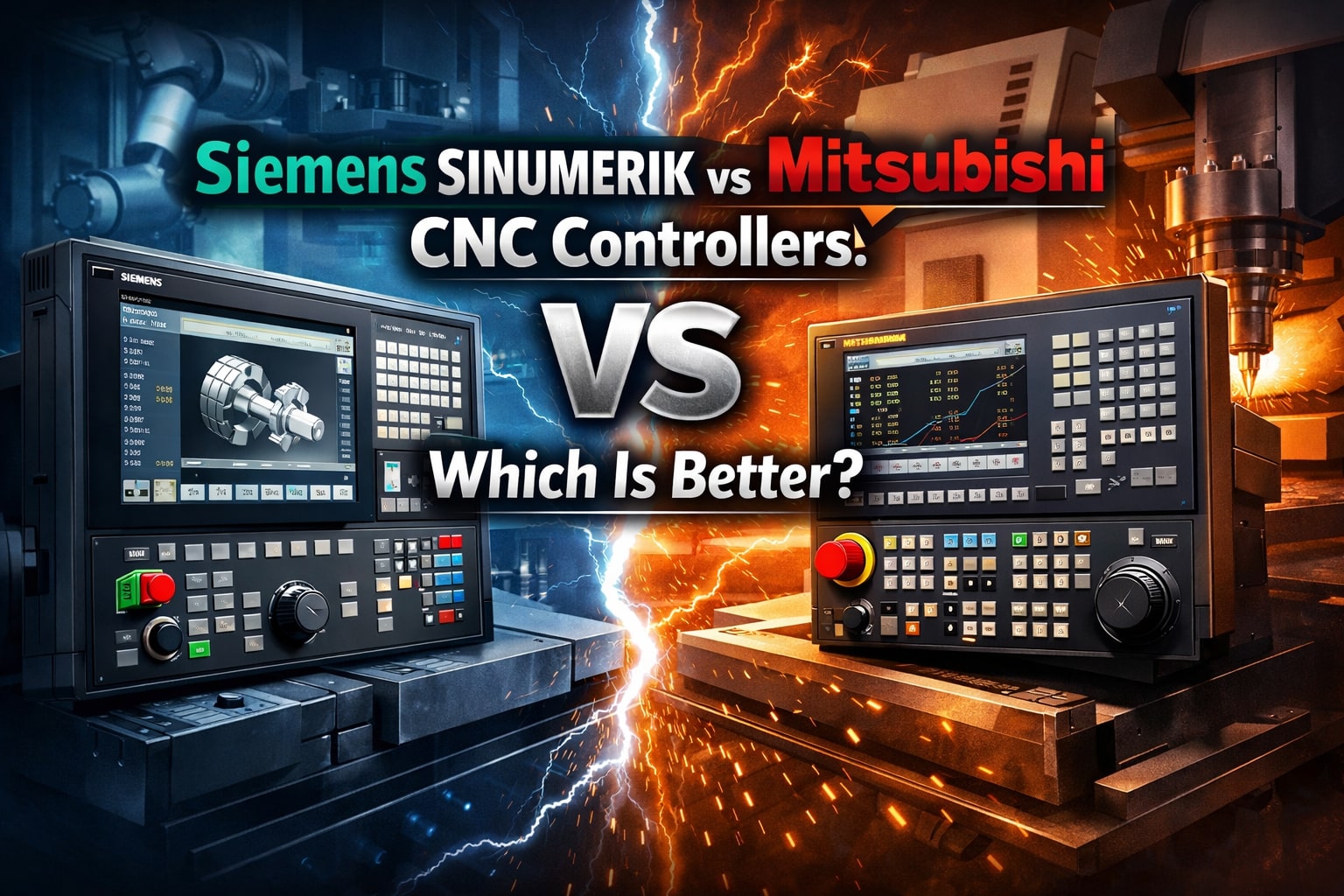
Choosing the right CNC controller is one of the most important decisions for any manufacturing business. The controller acts as the brain of your CNC machine. It controls every movement, every cut, and every operation on your shop floor.
Two major players dominate the CNC controller market: Siemens, with its SINUMERIK series, and Mitsubishi, with its M800/M80 series. Both brands have strong reputations. Both offer excellent performance. But which one is right for your factory?
In this guide, we break down everything you need to know about these two controller brands so you can make an informed decision.
What You Will Learn in This Guide:
- Overview of Siemens SINUMERIK and Mitsubishi CNC controller families
- Key differences in performance, precision, and processing speed
- User interface and ease of operation comparison
- Industry 4.0 and IoT connectivity features
- Pricing considerations and total cost of ownership
- Best use cases for each controller brand
- How to maximise your controller investment with machine monitoring
Understanding Siemens SINUMERIK Controllers

Siemens is a German company with over 100 years of experience in electrical engineering and automation. The SINUMERIK brand was registered in 1964, making it one of the oldest CNC control systems in the world.
Siemens SINUMERIK controllers are recognised for their advanced functionality, strong integration with digital manufacturing, and readiness for Industry 4.0. They hold a significant market share in Europe and are widely used in the aerospace, automotive, and medical device manufacturing industries.
SINUMERIK Product Family
Siemens offers multiple controller models to suit different needs:
- SINUMERIK 808D: Entry-level controller designed for price-sensitive markets. Best for small workshops and basic CNC machines. Offers simple commissioning and standard G-code programming.
- SINUMERIK 828D: Compact CNC for standard milling and turning machines. Offers high CNC performance with an integrated PLC. Popular choice for medium-scale manufacturing.
- SINUMERIK 840D sl: Premium class controller for multi-axis machining centres and complex applications. Maximum CNC performance with high flexibility. Considered the industry standard for high-end machine tools.
- SINUMERIK ONE: The latest generation controller introduced in 2019. Called the “digital native” CNC because it was built from the ground up for digital transformation. Features integrated digital twin technology for virtual simulation before production.
Key Features of Siemens SINUMERIK
- Digital Twin Technology: SINUMERIK ONE creates a complete virtual copy of your machine and control system. You can simulate machining processes in a virtual environment before running them on the actual machine. This reduces development time, minimises errors, and cuts commissioning costs.
- ShopMill and ShopTurn: Graphical interface programming that helps operators get started quickly with minimal training. Even operators with limited G-code knowledge can create programs efficiently.
- TIA Portal Integration: SINUMERIK ONE integrates with Siemens TIA Portal engineering framework. This enables standardisation of all engineering tasks for larger manufacturing plants.
- Safety Integrated: Built-in safety functions based on the S7 1500F PLC. Robust IT security measures protect against unauthorised access in Industry 4.0 environments.
- Multi Axis Control: SINUMERIK 840D sl can control up to 31 axes simultaneously. This makes it ideal for complex 5-axis machining and multi-spindle applications.
Understanding Mitsubishi CNC Controllers
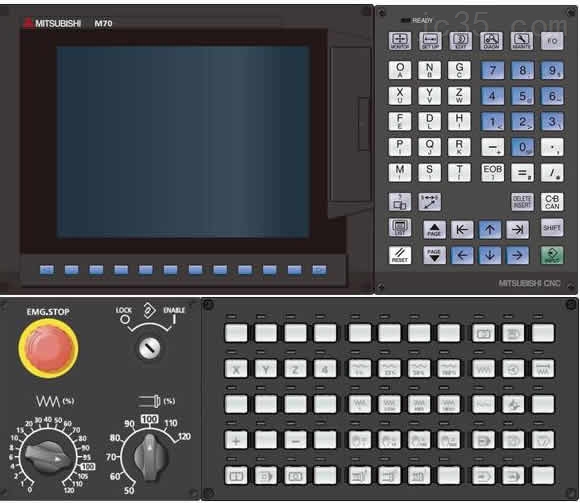
Mitsubishi Electric started developing CNC systems in 1956. With over 65 years of experience, they have built a strong reputation for high-speed, high-precision machining. Mitsubishi controllers are especially popular in Japan, China, and other parts of Asia.
The company is known for integrating its CNC controllers with its broader automation ecosystem, including PLCs, servo drives, and robots.
Mitsubishi CNC Product Family
- M700/M70 Series: Previous-generation controllers are still in use on many machines. Known for reliability and solid performance.
- M800 Series: High-grade CNC designed for high-speed, high-accuracy machining. Supports multi-axis and multi-part system control. Available in M800W (Windows-based display) and M800S (panel integrated) versions.
- M80 Series: Standard CNC that provides high productivity and easy operability. Comes as a package solution for easier selection. Features all functionalities included without additional options.
- M800V/M80V Series: Latest variants with enhanced features, including SSS 4G control for even better machining quality.
Key Features of Mitsubishi CNC
- CNC Dedicated CPU: Mitsubishi developed its first-ever CNC dedicated CPU for the M800/M80 series. This custom processor delivers phenomenal processing speed while reducing the number of required parts. Fewer parts mean fewer failure points and higher reliability.
- SSS 4G Control: Super Smooth Surface 4th generation control enables high speed, high accuracy, high quality machining. It provides optimal acceleration and deceleration suited to each axis. SSS 4G also reduces machine vibration during high-speed cutting.
- Intuitive Touch Interface: The M80 series features 10.4-inch and 15-inch capacitive touch screens. Icon-based navigation provides smartphone-like operation that operators can learn quickly.
- Interactive Cycle Insertion (ICI): A Simple programming system that lets operators create programs for each process easily. Clear interface displays tool paths and machining shapes without complex G-code knowledge.
- Smart Safety Observation Function: Full conformity with international safety standards, including IEC 61508, ISO 13849-1, and EN 62061.
Performance Comparison: Siemens vs Mitsubishi
Both controllers deliver excellent precision and performance. However, they have different strengths.
Processing Speed
- Mitsubishi M800/M80: The CNC dedicated CPU provides industry-leading processing speed. High capability in program processing enables shorter cycle times. The optical communication speed between the CNC and the drive has been increased for better system responsiveness.
- Siemens SINUMERIK ONE: Offers up to 10 times faster PLC cycle times compared to previous generations. The new hardware architecture and intelligent control algorithms ensure the highest dynamic performance.
- Winner: Both are extremely fast. Mitsubishi edges ahead slightly for pure processing speed. Siemens wins for complex PLC operations.
Machining Precision
- Mitsubishi: SSS 4G control provides smooth motion within specified error tolerances. OMR CC (Optimum Machine Response Contour Control) reduces cycle time without compromising accuracy by adjusting to workpiece shape.
- Siemens: SINUMERIK ONE uses advanced interpolation algorithms for exceptional surface finish. Digital twin technology allows operators to optimise tool paths before actual machining.
- Winner: Tied. Both achieve micron-level precision. Your results will depend more on machine quality and proper setup.
Multi Axis Control
- Siemens SINUMERIK 840D sl: Controls up to 31 axes. Ideal for complex 5-axis machining centres and multi-spindle turning.
- Mitsubishi M800 Series: Controls up to 8 part systems, 32 axes, and 8 spindles. Supports loader control and spindle synchronisation.
- Winner: Siemens has a slight advantage for the most complex multi-axis applications. Mitsubishi is excellent for most manufacturing needs.
User Interface and Ease of Operation
The user interface matters because it affects training time, operator efficiency, and error rates.
Siemens SINUMERIK
Siemens controllers have a reputation for being powerful but complex. The learning curve can be steep for operators who are new to CNC machining.
However, ShopMill and ShopTurn graphical programming simplify operations significantly. Operators can create programs by filling in dialogue boxes rather than writing G-code manually.
SinuTrain simulation software allows programs to be written offline and imported directly. This is valuable for training new operators without tying up production machines.
Mitsubishi CNC
Mitsubishi is known for its clean, simple interfaces. The touch screen operation is intuitive and quick to learn. Many users describe it as “smartphone-like” in its ease of use.
Icon-based navigation makes it easy for operators to find features without memorising menu structures. USB and SD card support allow easy backup and transfer of parameters and programs.
The NC Visualizer application displays machine status (operating, stopped, alarm, power off) in a list format. This helps operators monitor multiple machines efficiently.
Winner
Mitsubishi wins for ease of use. Operators can become productive faster with less training. Siemens wins for advanced features once operators are fully trained.
Industry 4.0 and IoT Connectivity
Modern manufacturing demands connected machines that can share data with enterprise systems.
Siemens SINUMERIK Industry 4.0 Features
Siemens leads in digital transformation capabilities:
- Digital Twin: SINUMERIK ONE creates a one-to-one virtual copy of the entire machine and control system. Machine builders use Create MyVirtualMachine for development. Users benefit from Run MyVirtualMachine for production optimisation.
- Cloud Connectivity: Full support for cloud computing, big data analytics, and IoT integration. MindSphere platform enables machine data analysis across multiple plants.
- Edge Computing: SINUMERIK Edge applications like Analyse MyMachine provide local data processing with cloud connectivity.
- TIA Portal: Centralised engineering platform for all Siemens automation components.
Mitsubishi CNC Connectivity Features
Mitsubishi offers solid connectivity through its e Factory ecosystem:
- MTConnect Support: The MTConnect Adapter is compatible with M800/M80 and M700/M70 series. This open protocol allows easy collection of machine data.
- Edgecross Integration: Data from MTConnect-compatible devices can be imported into Edgecross for edge applications.
- Field Network Support: Compatible with CC Link, PROFIBUS DP, and EtherNet/IP. Connects to peripheral equipment and factory automation systems.
- NC Visualizer: An Operation monitoring application that displays machine status on server PCs. Operators can monitor machines remotely via a web browser.
- NC Machine Tool Connector: Software that collects operation data and PLC device data. Provides collected data to host IT systems and industrial platforms.
Winner
Siemens wins for Industry 4.0 features. The digital twin technology and MindSphere ecosystem are more mature and comprehensive. Mitsubishi provides solid connectivity that meets most factory needs.
Pricing and Total Cost of Ownership
Pricing varies significantly based on model, configuration, and region. Here are general guidelines:
Siemens SINUMERIK Pricing
Siemens controllers are generally more expensive than competitors. SINUMERIK 840D sl and SINUMERIK ONE are premium products with premium prices.
Entry-level SINUMERIK 808D retrofit kits start around $14,000 to $18,000 USD for basic 3-axis configurations.
High-end SINUMERIK 840D SL systems can cost significantly more depending on axis count and options.
Many advanced features require additional licensing fees. This can increase the total cost of ownership over time.
Mitsubishi CNC Pricing
Mitsubishi positions itself as cost-effective compared to Siemens and FANUC. The M80 series comes with all features included without additional options.
This “all-inclusive” approach means no surprise licensing fees. You know the total cost upfront.
Mitsubishi also integrates smoothly with other Mitsubishi automation products (PLCs, drives, motors). If you already use Mitsubishi equipment, the integration savings can be significant.
Winner
Mitsubishi wins on initial cost and total cost of ownership. Siemens may deliver better ROI for factories that fully utilise digital twin and Industry 4.0 features.
Service and Support
Siemens Support
Siemens has strong coverage in Europe and parts of North America. Support in Asia and South America may take longer to access.
Documentation is comprehensive but can be overwhelming for new users. Training programs are available but typically require additional investment.
Mitsubishi Support
Mitsubishi has excellent support in Asia, especially Japan and China. Their service network in Europe and North America is growing, but not as extensive as Siemens’s.
Users report that Mitsubishi provides good support for older hardware. This is important for factories that keep machines running for 10 to 15 years.
Winner
Depends on your location. Siemens in Europe. Mitsubishi in Asia. Both provide adequate support in North America.
Best Use Cases
Choose Siemens SINUMERIK When:
- You operate in Europe, where Siemens’ support is strongest
- You need advanced 5-axis or multi-axis machining capabilities
- Digital twin and virtual commissioning are priorities
- You are building a smart factory with full Industry 4.0 integration
- You manufacture aerospace, medical devices, or other high-precision parts
- You use other Siemens automation products and want unified engineering
Choose Mitsubishi CNC When:
- You operate in Asia, where Mitsubishi support is strongest
- Cost-effectiveness is a priority
- You need fast operator training with intuitive interfaces
- You already use Mitsubishi PLCs, drives, or robots
- You want all features included without hidden licensing fees
- You manufacture automotive, electronics, or metal cutting parts
Maximising Your Controller Investment With Machine Monitoring
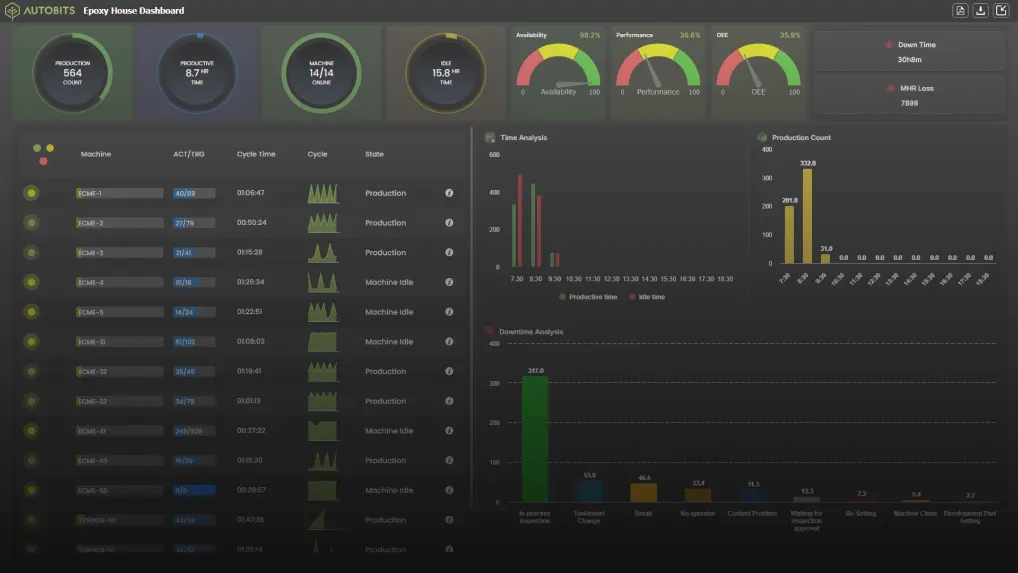
Regardless of which controller you choose, you need visibility into how your machines are actually performing. The controller tells the machine what to do. Machine monitoring software tells you what the machine is actually doing.
Modern CNC controllers from both Siemens and Mitsubishi support data collection through protocols like MTConnect and OPC. This data can be captured by machine monitoring systems to provide:
Real Time OEE Tracking: See availability, performance, and quality metrics across your shop floor. Identify which machines are underperforming and why. Learn more about what OEE is in manufacturing.
Downtime Analysis: Capture every stop event automatically. Categorise downtime by reason codes to find patterns. Check out our guide on strategies to improve OEE.
Predictive Maintenance: Monitor machine health parameters like vibration, temperature, and power consumption. Detect problems before they cause unplanned downtime. Read more about predictive maintenance with APM software.
Production Visibility: Know exactly where every job stands. Track cycle times against standards. Get alerts when production falls behind schedule.
Both Siemens SINUMERIK and Mitsubishi CNC controllers can be integrated with Autobits CNC Machine Monitoring Software. Our IIoT gateway collects data directly from your controllers regardless of brand. This gives you unified visibility even if you have a mixed fleet of machines.
Learn more about CNC machine monitoring data collection methods and how to improve productivity on CNC machines.
Making the Right Choice
The debate between Siemens SINUMERIK and Mitsubishi CNC controllers does not have a single right answer. Both are excellent products from world-class manufacturers.
Consider these factors in your decision:
- Geographic location: Where is your factory? Where will you need support?
- Existing equipment: What automation products do you already use?
- Application complexity: How many axes? What level of precision?
- Digital transformation goals: How important is Industry 4.0 integration?
- Budget: What is your upfront budget? What can you afford long-term?
- Operator skill level: How quickly do new operators need to become productive?
Talk to machine builders and ask which controllers they support best. Visit reference sites using each controller. Let your operators test both interfaces before making a final decision.
Whatever controller you choose, remember that the hardware is just the starting point. The real value comes from how you use it. Proper training, optimised programs, and real-time monitoring will determine whether you achieve the productivity gains you expect.
Frequently Asked Questions
Which controller is more reliable?
Both Siemens and Mitsubishi have excellent reliability records. Mitsubishi’s CNC dedicated CPU reduces the number of components, which theoretically reduces failure points. Siemens has decades of proven performance in demanding applications.
Can I switch from Siemens to Mitsubishi or vice versa?
Retrofitting a machine with a different controller brand is possible, but expensive. It requires new hardware, wiring, and programming. Operators will also need retraining. Most factories stick with one controller brand for consistency.
Which controller is better for 5-axis machining?
Both handle 5-axis machining well. Siemens SINUMERIK 840D sl has a slight edge for the most complex applications. The Mitsubishi M800 series is excellent for most 5-axis work.
Do I need machine monitoring if my controller already shows data?
Yes. Controllers show data for individual machines. Machine monitoring software aggregates data across your entire shop floor. It provides historical trends, OEE calculations, and alerts that controllers do not offer.
Which controller has better resale value?
Siemens-controlled machines generally command higher resale prices, especially in Europe and North America. Mitsubishi-controlled machines hold value well in Asian markets.
Conclusion
Siemens SINUMERIK and Mitsubishi CNC controllers are both capable of delivering excellent results in modern manufacturing. Siemens leads in Industry 4.0 integration and digital twin technology. Mitsubishi offers better value and easier operation.
Your choice should be based on your specific needs, location, existing equipment, and budget.
Once you have chosen your controller, focus on getting the most from your investment. Train your operators well. Optimise your programs. And implement machine monitoring to track performance and identify improvement opportunities.
Ready to see how your CNC machines are really performing? Contact Autobits to learn how our machine monitoring solution works with both Siemens and Mitsubishi controllers.
Related Resources
For more insights on CNC controllers and machine monitoring, check out these guides: