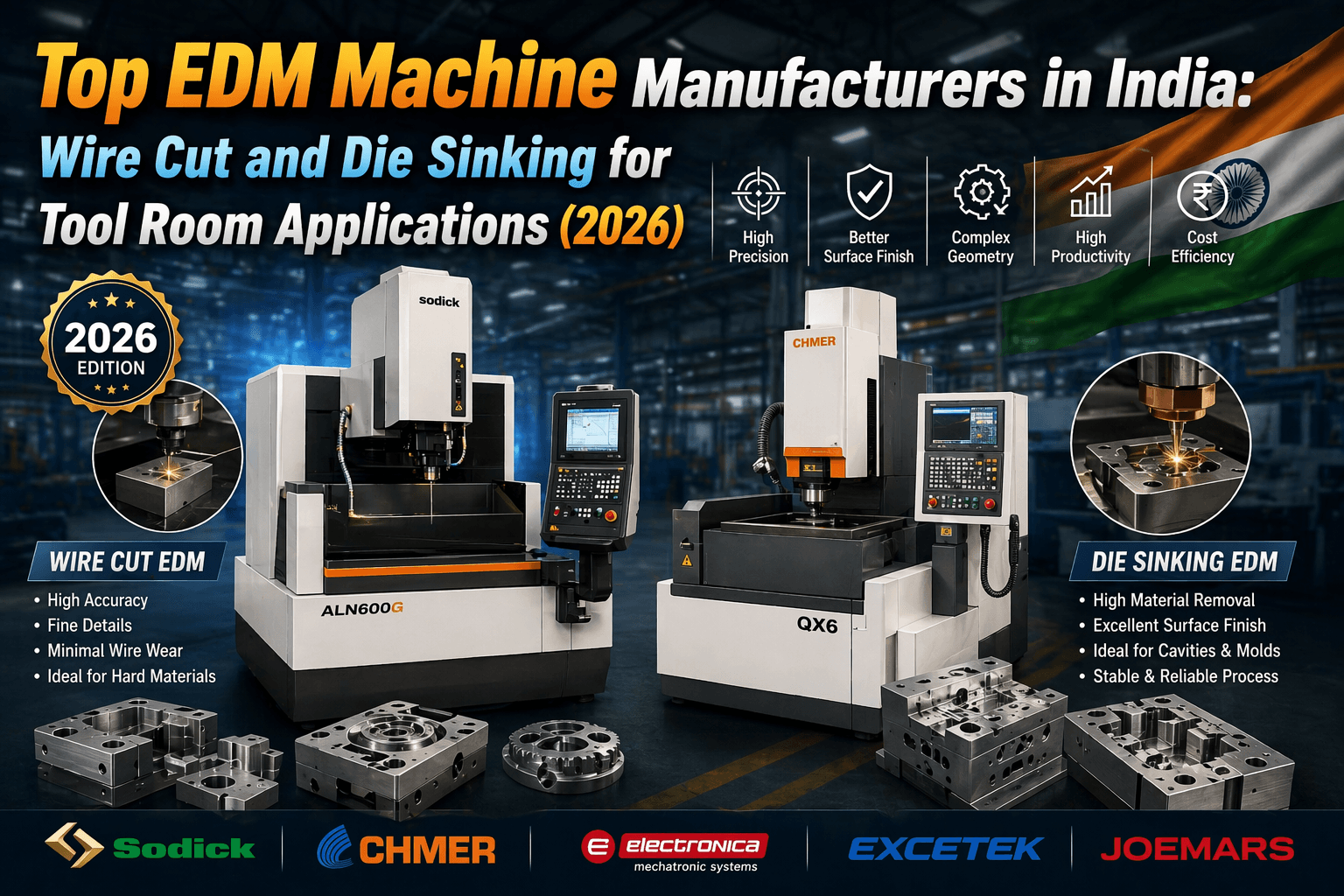
The top EDM machine manufacturers in India include Mitsubishi Electric, Sodick, Fanuc, Makino, Charmilles (GF Machining Solutions), Electronica, and Sparkonix. EDM machines are used for wire cutting and die sinking in tool rooms, die-mold shops, and precision component manufacturing. Prices in India range from ₹18 lakh for domestic wire-cut EDM to ₹1.2 crore for premium die-sinking centers.
Why EDM Remains Irreplaceable in Indian Tool Rooms and Die-Mold Shops
Electrical discharge machining is one of the few manufacturing processes that has no direct substitute when the job demands it. When a material is too hard to cut with a conventional tool, when a feature geometry is too complex to reach with a rotating cutter, or when the surface finish required is beyond what milling can achieve, EDM is the answer.
In India, EDM machines are the backbone of the tool room, die-mold, and precision component manufacturing ecosystem. Every automotive die, every injection mold insert, every precision gauge, and every hardened steel component with tight corners and fine surface finish has almost certainly been touched by an EDM process somewhere in its production journey.
The Indian EDM market has matured considerably. A decade ago, the market was dominated by imported Swiss and Japanese machines. Today, strong Indian manufacturers like Electronica and Sparkonix compete directly with global brands in the mid-range segment, while Japanese and Swiss machines continue to dominate the high-precision end.
This guide covers the top 10 EDM machine manufacturers serving India, the technical distinctions between wire-cut and die-sinking EDM, realistic price ranges, and the specifications that matter most for Indian tool room and die-mold applications.
What Is EDM Machining?
Electrical Discharge Machining (EDM) is a manufacturing process that removes material from a workpiece using controlled electrical sparks. There is no physical contact between the cutting tool and the workpiece. Instead, rapid electrical discharges between an electrode and the workpiece erode material from the workpiece surface.
Because there is no cutting force involved, EDM can machine any electrically conductive material regardless of hardness. Hardened tool steel at 60 HRC, tungsten carbide, titanium, and Inconel are all machined as readily as mild steel.
There are two primary types of EDM machines used in Indian manufacturing:
Wire Cut EDM (WEDM)
Wire cut EDM uses a thin brass wire (typically 0.1 to 0.3 mm diameter) as the electrode. The wire is continuously fed from a spool and travels through the workpiece while electrical discharges erode a narrow slot called the kerf. The wire never touches the workpiece.
Wire cut EDM is used for:
- Cutting complex 2D and tapered profiles in hardened steel
- Producing punches and dies for stamping tools
- Cutting extrusion dies and drawing dies
- Machining precision slots, keyways, and profile forms
- Cutting carbide inserts and forming tools
Die Sinking EDM (Ram EDM)
Die sinking EDM uses a shaped electrode (typically machined from copper or graphite) that is plunged into the workpiece. The electrode shape is the mirror image of the cavity required. Electrical discharges between the electrode and the workpiece erode the workpiece to the shape of the electrode.
Die sinking EDM is used for:
- Producing mold cavities in hardened steel
- Machining blind pockets and ribs that cutters cannot reach
- Creating sharp internal corners that milling leaves as radii
- Texturing mold surfaces for aesthetic finishes
- Machining deep narrow slots and fine detail in die-mold inserts
How We Selected These Manufacturers
Each manufacturer was evaluated across five criteria:
Machining accuracy and surface finish: Positional accuracy of the wire or electrode, achievable surface roughness (Ra value), and taper accuracy on wire cut machines.
Generator technology: The quality and sophistication of the spark generator determines cutting speed, surface finish, and electrode wear. Advanced generators with digital control of pulse parameters deliver both speed and finish.
Software and CAD/CAM integration: Quality of the built-in CAM software for wire path generation and compatibility with external CAD systems.
After-sales service in India: Number of trained service engineers, response time commitment, and spare parts availability from local stock.
Price to performance at each market segment: Value delivered relative to machine price for Indian tool room and die-mold applications.
Top 10 EDM Machine Manufacturers Serving India
1. Mitsubishi Electric India
Headquarters: Tokyo, Japan India Operations: Delhi NCR, with regional offices EDM Range: MV series wire cut, MX series wire cut, SV series die sinker, EA series die sinker
Mitsubishi Electric is widely regarded as the benchmark in high-precision wire cut EDM globally and holds a strong position in India’s premium tool room market. Their MV series wire cut EDM machines incorporate their own advanced digital power supply technology which delivers faster cutting speeds with better surface finish compared to earlier generation machines.
The MV2400S and MV4800S are their most commonly installed wire cut EDM machines in Indian tool rooms for automotive stamping die production. The EA series die sinkers are preferred in precision injection mold shops for their ability to produce fine mold cavity detail with minimal electrode wear.
Mitsubishi’s local presence through their India operations includes trained applications engineers who support the commissioning and process development phase for Indian customers.
Best for: Automotive stamping dies, precision injection mold cavities, high-accuracy wire profiles in hardened steel.
2. Sodick (India)
Headquarters: Yokohama, Japan India Operations: Through authorized distributors in Pune, Delhi, Bengaluru EDM Range: AG series wire cut, AQ series wire cut, SL series die sinker, AD series die sinker
Sodick is recognized globally for one specific technology advantage: their linear motor drive system. Conventional EDM machines use ball-screw drives. Sodick replaced ball-screws with linear motors on both the wire cut and die sinker ranges, eliminating mechanical backlash entirely.
In practical terms, this means Sodick machines maintain their positioning accuracy over a much longer operating life because there are no ball-screws to wear out. For Indian tool rooms running high-duty cycles, the long-term accuracy retention of Sodick machines is a compelling investment argument.
The AQ750L and AQ900L wire cut machines are widely used in Indian precision engineering companies for carbide punch and die production and tight-tolerance profile cutting.
Best for: Long-term precision retention, high-duty cycle tool rooms, carbide cutting, precision punch and die production.
3. GF Machining Solutions (Charmilles, India)
Headquarters: Geneva, Switzerland India Operations: Through Georg Fischer distributors EDM Range: CUT series wire cut (CUT 300, CUT 2000), FORM series die sinker (FORM 200, FORM 20)
Charmilles, now part of the GF Machining Solutions group, pioneered wire cut EDM technology in the 1960s and remains one of the most respected names in global EDM. Their CUT series wire cut machines incorporate the Intelligent Speed Power Generator (ISPG) which automatically optimizes spark parameters for the material and thickness being cut.
The CUT 2000 series achieves surface finishes in the Ra 0.08 micrometer range, which meets the surface quality requirements for optical mold inserts and precision medical tooling. For Indian mold makers producing consumer electronics molds and medical device tooling where optical surface quality is required, Charmilles machines deliver capabilities that few competitors can match.
Best for: Optical quality mold inserts, medical device tooling, precision die production requiring finest surface finish.
4. Fanuc (India)
Headquarters: Oshino, Japan India Operations: Gurgaon, with service centers in major manufacturing cities EDM Range: ROBOCUT series wire cut (a-CiA, a-DiA series)
Fanuc brings their renowned CNC control expertise to the EDM market. The ROBOCUT series wire cut machines run on Fanuc’s own CNC platform, which means the control interface will be immediately familiar to any CNC operator who has worked on Fanuc-controlled machining centers or lathes.
This familiarity advantage is significant in Indian plants where operator training time and cross-training flexibility matter. The ROBOCUT a-C600iA with its 600 mm x 400 mm work tank is the most popular Fanuc wire cut machine in Indian automotive and tooling applications.
Fanuc’s service network in India is the strongest of any Japanese machine tool brand, with service engineers available in virtually every major manufacturing city.
Best for: Plants standardizing on Fanuc control platforms, automotive tooling, shops wanting Fanuc service support for their EDM fleet.
5. Makino (India)
Headquarters: Narita, Japan India Operations: Bengaluru EDM Range: U series wire cut, EDGE series die sinker
Makino’s EDM range is designed for the precision die-mold and aerospace tooling sectors. Their U3, U6, and U8 wire cut machines are designed for very high-precision multi-axis wire cutting with automatic wire threading even in submerged dielectric conditions.
The EDGE2 and EDGE3 die sinker series from Makino are particularly strong in deep rib and narrow slot machining for plastic injection molds. Their HyperCut technology optimizes spark parameters for finishing passes, achieving Ra 0.2 to 0.4 micrometer surface finish in a single finishing cycle that would otherwise require multiple passes on conventional machines.
Best for: Precision injection mold inserts, deep rib and narrow slot machining, aerospace tooling.
6. Electronica Machine Tools
Founded: 1974 Headquarters: Pune, Maharashtra EDM Range: ECOCUT series wire cut, Electronica die sinker range
Electronica Machine Tools is India’s largest domestic EDM manufacturer and one of the oldest established precision machine tool companies in the country. Their ECOCUT series wire cut EDM machines are designed specifically for Indian manufacturing conditions, including power supply fluctuation tolerance and ease of operator training.
Electronica’s greatest advantage is their after-sales service network. They have service engineers and spare parts stocked across India at a density that no imported brand can match. For Indian tool rooms in Tier 2 and Tier 3 cities where imported brand service response is measured in days, Electronica’s same-day or next-day service commitment is a decisive practical advantage.
Their machines are used across Indian automotive die shops, general tool rooms, and educational institutions. They represent the most practical entry point for Indian manufacturers adopting wire cut EDM for the first time.
Best for: Tier 2 and Tier 3 city tool rooms, first EDM purchase, educational institutions, general automotive die production.
7. Sparkonix (India)
Founded: 1965 Headquarters: Pune, Maharashtra EDM Range: Sparkonix die sinker range, SPARK series wire cut
Sparkonix is one of India’s pioneering EDM manufacturers. They introduced EDM technology to the Indian market in the 1960s and have built a loyal customer base in Indian tool rooms over six decades. Their die sinking machines are particularly well-regarded in Indian automotive stamping die shops.
The Sparkonix brand carries strong recognition in Maharashtra’s automotive tooling ecosystem. Their machines are known for robust construction, straightforward operation, and maintenance that can be handled by in-house tool room technicians without specialized service engineers.
Best for: Indian automotive tool rooms, die sinking applications, shops wanting a proven domestic brand with long-term support heritage.
8. Accutex (India)
Headquarters: Taichung, Taiwan India Operations: Through distributors in major manufacturing centers EDM Range: AU series wire cut, UR series wire cut, AP series wire cut
Accutex occupies the mid-range of the Indian wire cut EDM market. Their machines offer a strong combination of accuracy and value, typically priced 20 to 30 percent below equivalent Japanese machines while delivering performance that meets the requirements of most Indian automotive and general engineering tool rooms.
Their AU-500iE and AU-650iE models with submerged cutting capability are the most commonly specified Accutex machines in Indian precision engineering applications. The Accutex control interface is intuitive and supports DXF import for direct wire path programming from CAD files.
Best for: Cost-conscious Indian tool rooms, automotive punch and die production, general precision wire cutting.
9. Seibu (India)
Headquarters: Tokyo, Japan India Operations: Through specialized distributors EDM Range: M series wire cut, MQ series high-precision wire cut
Seibu is a specialist wire cut EDM manufacturer with a focus on ultra-high precision applications. Their MQ series machines achieve positioning accuracy in the sub-micron range, making them the reference machine for precision gauge manufacturing, connector tooling, and fine blanking die production.
In India, Seibu machines are found in precision instrument manufacturing facilities, research institutions, and specialized tooling companies producing fine blanking dies and precision stamping tools.
Best for: Ultra-precision wire cutting, fine blanking dies, connector tooling, precision gauge production.
10. Ocean Technologies (India)
Headquarters: Taichung, Taiwan India Operations: Through distributors across India EDM Range: OPS series wire cut, die sinker series
Ocean Technologies represents the entry to mid-range segment of the Indian EDM market. Their wire cut machines are designed for straightforward tooling applications where the priority is reliable cutting of standard profiles in hardened steel at an accessible price point.
For Indian job shops and general engineering tool rooms that need a functional wire cut EDM machine without the investment associated with Japanese or Swiss brands, Ocean Technologies offers a practical starting point.
Best for: Entry-level wire cut EDM applications, general tool room profiles, price-sensitive manufacturers.
EDM Machine Price Range in India (2026)
Wire Cut EDM Prices
| Category | Manufacturer Origin | Approx. Price Range | Typical Application |
| Entry Level | Indian and Taiwanese brands | ₹18 lakh to ₹35 lakh | General profile cutting, stamping dies |
| Mid Range | Japanese and premium Taiwanese | ₹35 lakh to ₹70 lakh | Automotive dies, precision punch and die |
| Premium | Swiss and high-end Japanese | ₹70 lakh to ₹1.2 crore | Optical mold inserts, medical tooling |
Die Sinking EDM Prices
| Category | Manufacturer Origin | Approx. Price Range | Typical Application |
| Entry Level | Indian brands | ₹12 lakh to ₹25 lakh | General mold cavity, basic die sinking |
| Mid Range | Japanese mid-range | ₹25 lakh to ₹60 lakh | Injection mold cavities, automotive dies |
| Premium | Swiss and high-end Japanese | ₹60 lakh to ₹1.2 crore | Precision mold inserts, aerospace tooling |
Wire Cut EDM vs Die Sinking EDM: Which Do You Need?
| Factor | Wire Cut EDM | Die Sinking EDM |
| Process | Thin brass wire cuts through material | Shaped electrode burns cavity into material |
| Best for | 2D profiles, punches, dies, slots | 3D cavities, ribs, pockets, mold inserts |
| Internal corners | Cannot produce true internal corners | Can produce sharp internal corners |
| Electrode required | No (wire is the electrode) | Yes (copper or graphite electrode required) |
| Workpiece must be through-cut | Yes | No (blind pockets possible) |
| Surface finish capability | Ra 0.1 to 0.8 micrometer | Ra 0.2 to 1.6 micrometer |
| Typical material hardness | Any conductive material | Any conductive material |
| Programming complexity | Moderate (2D to 4-axis wire path) | Higher (3D electrode design required) |
Many Indian tool rooms operate both types. Wire cut EDM produces punches and die profiles. Die sinking EDM produces mold cavities and complex 3D features that the wire cannot reach.
Key Specifications to Evaluate in an EDM Machine
Work Tank Dimensions and Maximum Workpiece Weight
The work tank must accommodate your largest regular workpiece. Check X, Y, and Z axis travel as well as the maximum workpiece weight the machine table can support. For large automotive dies, machines with 800 mm x 600 mm travel and 1,000 kg table load are commonly required.
Surface Finish Capability (Ra Value)
The surface finish achievable in a single setup (without additional polishing) determines whether the machine fits your application. Mold inserts for transparent optical parts require Ra below 0.1 micrometer. General tooling accepts Ra 0.4 to 0.8 micrometer. Confirm the manufacturer’s surface finish claims with a test cut on your material.
Maximum Cutting Speed
Cutting speed is measured in mm² per minute of cross-sectional area cut per hour. For standard 50 mm thick die steel, a productive mid-range wire cut machine achieves 350 to 500 mm²/min in roughing mode. Premium machines exceed 600 mm²/min. Higher cutting speed means shorter cycle time and more parts per shift.
Wire Threading System
Automatic wire threading (AWT) is essential for unmanned operation. The machine must be able to automatically rethread the wire if it breaks during an unattended cutting run. Submerged AWT is the most reliable system and is preferred for overnight unattended operation.
Taper Cutting Capability
Most modern wire cut EDM machines can cut tapered profiles up to 30 degrees from vertical. Some specialized machines reach 45 degrees. If your application requires extrusion dies or progressive die components with significant taper, confirm the machine’s maximum taper angle.
Generator and Pulse Control
The spark generator determines both cutting speed and surface finish quality. Digital generators that allow precise control of pulse-on time, pulse-off time, and peak current in finishing mode deliver better surface finish repeatability than analog generators. Ask specifically about the number of finishing power settings and the smallest achievable discharge energy for fine finishing.
Electrode Materials for Die Sinking EDM in India
Die sinking EDM requires a separate machined electrode for each cavity feature. The choice of electrode material significantly affects machining speed, electrode wear, and achievable surface finish.
- Graphite electrodes: The most common electrode material in Indian die sinking EDM shops. Graphite is easy to machine with a high-speed mill or CNC router, has low electrode wear in roughing mode, and handles large cavity work efficiently. Graphite dust requires proper extraction systems.
- Copper electrodes: Copper delivers finer surface finish than graphite and is preferred for fine detail work in precision mold inserts. It is denser than graphite, easier to polish, and does not generate dust. Machining copper electrodes is slower than graphite.
- Copper tungsten electrodes: Used for machining cemented carbide (tungsten carbide tooling). Copper tungsten has the lowest wear rate of all electrode materials when machining carbide and is essential for precision carbide punch and die production.
How Machine Monitoring Supports EDM Operations
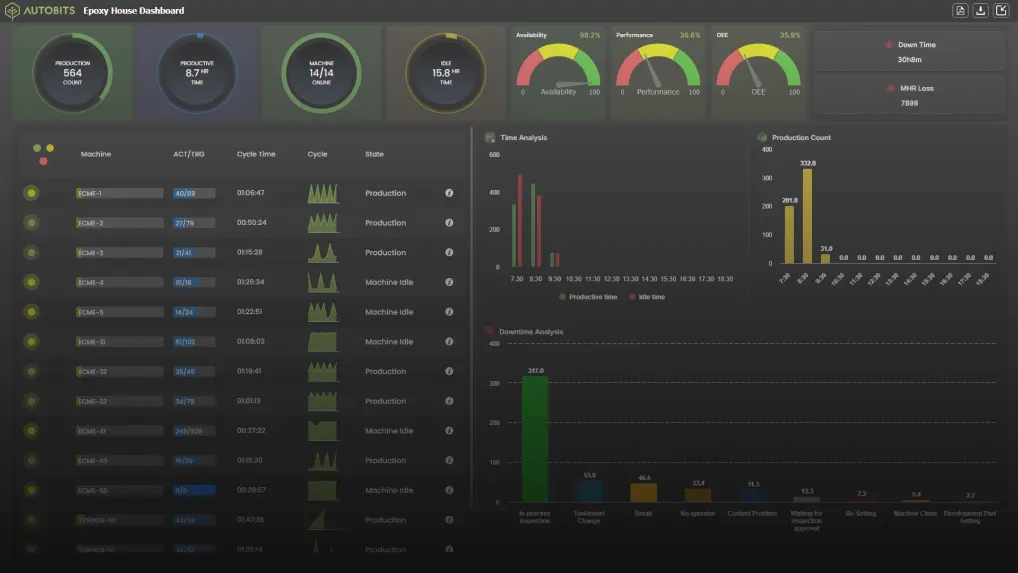
EDM machines run long, unattended cutting cycles. A wire cut EDM cutting a complex automotive die profile may run for 8 to 16 continuous hours. A die sinker producing a deep mold cavity may run overnight. During these long unattended runs, problems can occur and go undetected for extended periods.
Machine monitoring software adds a critical visibility layer to EDM operations:
- Cycle status monitoring: Know in real time whether the EDM machine is cutting, in wire threading, in alarm state, or idle. Without monitoring, a machine that trips an alarm at 2 AM on a long overnight run sits idle until an operator arrives in the morning.
- Alarm alerting: Instant notifications when the machine enters an alarm state allow maintenance or operators to respond remotely rather than discovering the problem at shift start.
- Cycle time tracking: Comparing actual cutting cycle time against planned cycle time on repeat jobs identifies whether cutting speed has degraded, which may indicate electrode wear, worn guides, or a dielectric system issue.
- Machine utilization reporting: EDM machines are often among the lowest-utilization machines in a tool room because of the time required for electrode preparation, setup, and programming. Monitoring quantifies exactly where time is being lost.
- Shift-level production reports: Automated reports of EDM machine cycles completed per shift replace manual paper-based logs and give supervisors accurate data without relying on operator reporting.
For EDM machines with Fanuc or Mitsubishi CNC controls, Autobits connects directly to the controller to provide complete access to machine data. For older EDM machines with proprietary controls, an IIoT gateway with digital input monitoring captures machine state from auxiliary outputs.

FAQ: EDM Machine Manufacturers in India
Q1. Which is the best wire cut EDM machine brand in India for a tool room?
For a well-established Indian tool room with volume die production, Mitsubishi Electric and Sodick are the benchmark choices for precision and long-term accuracy retention. For a tool room prioritizing accessibility to after-sales service across India, Electronica Machine Tools is the most practical domestic option. For mid-range price and performance, Accutex from Taiwan offers strong value. The right choice depends on your precision requirements, city location, and service expectations.
Q2. What is the price of a wire cut EDM machine in India in 2025?
Wire cut EDM prices in India range from approximately ₹18 lakh for entry-level domestic or Taiwanese machines to ₹1.2 crore for premium Japanese and Swiss high-precision machines. Mid-range Japanese wire cut EDM machines with submerged cutting and automatic wire threading typically cost ₹35 lakh to ₹70 lakh. All prices are subject to GST and installation costs.
Q3. Can EDM machines be connected to machine monitoring software?
Yes. Most modern EDM machines from Japanese and Swiss manufacturers use Fanuc, Mitsubishi, or proprietary CNC controls that support data output via RS-232, Ethernet, or OPC-UA. Autobits connects to Fanuc-controlled EDM machines via FOCAS protocol. For EDM machines with proprietary controls that lack standard network interfaces, an IIoT gateway captures machine state (cutting, idle, alarm) from digital signal outputs on the machine electrical panel without any modification to the controller.
Q4. What is the difference between graphite and copper electrodes in die sinking EDM?
Graphite electrodes are faster to machine, lighter, and wear less in roughing mode, making them the preferred choice for large cavity work and where machining time is the priority. Copper electrodes deliver better surface finish in fine finishing passes and are preferred for precision mold inserts where Ra below 0.4 micrometer is required. Copper is also preferred when machining carbide or when the mold shop polishes electrodes to a mirror finish before use.
Q5. How do I choose between wire cut and die sinking EDM for my tool room?
If your primary work is producing punches, dies, cutting profiles, and through-features in hardened steel, wire cut EDM is your primary requirement. If your primary work is producing mold cavities, blind pockets, deep ribs, and 3D features that cutters cannot reach, die sinking EDM is your primary requirement. Most established Indian tool rooms operate both types because they serve complementary functions. If you are buying your first EDM machine, evaluate your most common workpiece type and dominant application before deciding which type to purchase first.
Read More
- Top CNC Machine Manufacturers in India: A Detailed Overview
- Top CNC Grinding Machine Manufacturers in India
- Top VMC Machine Manufacturers in India
- Types of CNC Machines
- How CNC Machines Work: A Detailed Guide
- Machine Condition Monitoring Guide
- CNC Machine Monitoring Data Collection Methods
- IIoT Integration Based CNC Machine Monitoring
- Edge IIoT Gateway Remote Diagnostics and Setpoint
- Real-Time Production Monitoring Software